
IoTeX
EVM-compatible L1 purpose-built for DePIN and real-world AI. Device identity (ioID), ZK-verified data (W3bstream), 7+ years mainnet. MiCA-compliant, CF Benchmarks listed. ~$2M TVL.
The most technically differentiated DePIN chain with verifiable innovations in device identity and ZK verification. Seven years of building with ~$2M TVL, but MiCA compliance, CF Benchmarks listing, and the Real-World AI Foundry signal institutional maturation. The ioTube bridge exploit ($4.4M, February 2026) is a setback.
- + Most technically differentiated DePIN chain: ioID device identity and W3bstream ZK-verified data
- + MiCA compliance, CF Benchmarks IOTXUSD_RTI index, HashKey IOTX/HKD listing. Concrete institutional on-ramps
- + Real-World AI Foundry launched October 2025 with Vodafone, Filecoin, Theta, Aethir, HashKey Chain and 20+ partners
- − ~$2M TVL after seven years and $70M+ funding; adoption has not matched the technology
- − ioTube bridge exploit (February 2026) stole $4.4M via a single compromised validator contract owner
- − Narrative pivot fatigue: IoT → MachineFi → DePIN → DePIN x AI → Edge AI across eight years
IoTeX scores solidly in the partially decentralised range. Strongest in data sovereignty (ioID and W3bstream provide genuine device-level data control with ZK verification) and open source transparency. Main centralisation concerns are the small producing set (a 36-seat pool and 24-seat committee, from 69 active candidates), foundation-controlled implementation, and low governance voter turnout.
Infrastructure decentralisation12/20
Own L1 with Roll-DPoS. The staking protocol lists 123 registered candidates, 69 with the 1M IOTX self-stake to be active; the top 36 by votes form the delegate pool (genesis NumCandidateDelegates 36) and a 24-member committee (NumDelegates 24) is drawn per epoch via VRF; nine delegates by vote weight exceed a third (read 2026-10-04 via eth_call candidates(0,300) on the staking protocol 0x04c22afae6a03438b8fed74cb1cf441168df3f12 at babel-api.mainnet.iotex.io). Permissionless node operation. Small delegate set and foundation's role in upgrades are centralisation vectors. Mainnet live since April 2019. Scored 12 (was 13, 2026-09-25): the 24-seat committee from a 36-seat pool with a third of vote weight in nine delegates (rested on a '50-candidate' explorer figure on 2026-09-25 that the 2026-10-04 staking-protocol read does not reproduce; the producing set is unchanged), plus Foundation-steered upgrades, sits in the 9-12 'some centralisation vectors' band, at its top, rather than the band above.
Governance decentralisation8/20 Established
Token voting exists and the team retains implementation control, which is the 5-8 band rather than the 9-12 "functional governance" band this score previously claimed. The IIP process runs on Snapshot and has not held a vote since IIP-40 on 28 October 2024. Seventeen proposals sit in the space and the newest is nearly two years old. IIP-42 never appeared there and reads Status: Draft in IoTeX's own repository; IIP-50 is a Draft too, and IIP-54 does not exist in it. Authoring an IIP and ratifying one are separate acts, and only the first is still happening. Placed at the top of the band because the historical process was real: turnout ran from 485 votes in October 2021 to 140 on the last proposal, on genuine protocol matters. Foundation and MachineFi Lab retain implementation control. Next hard fork without a vote: iotex-core v2.5.0 (required, 28 Sep 2026) schedules Zanzibar at block 53,533,081 (postponed from 53,155,801; ~19 Oct 2026 at 2.5s blocks from height 53,020,556 on 2026-10-04), switching on IIP-59 protocol-native voter rewards in place of off-chain Hermes, while IIP-59 reads Status: Draft and Snapshot has no vote since IIP-40 (https://github.com/iotexproject/iotex-bootstrap/blob/master/changelog/v2.5.0-release-note.md).
IoTeX's Snapshot governance space has not held a token-holder vote since IIP-40 in October 2024. Seventeen proposals, and the last of them is IIP-40 on 28 October 2024; nothing has been put to a token-holder vote since. IIP-42 does not appear in the space, and the IIP document reads Status: Draft, created 20 March 2025; IIP-50 is also a Draft, IIP-52 carries no status line, and IIP-54 does not exist in the repository. Turnout was falling before the silence: 485 votes in October 2021 against 140 on the last proposal. The space's own declared website is https://iotex.io/, which binds it to the project. Proposal count, last-proposal date and per-proposal turnout from Snapshot Hub's keyless GraphQL API. The space is bound to the project by the website the SPACE declares matching the project's identity.website, asserted on every refresh rather than at authoring time, because a Snapshot id is just a string and matching on name is the ambiguous-ticker trap. The rated figure is the PROPOSAL COUNT and not days-since-last-proposal: a day counter drifts daily and trains everyone to ignore it, while the count moves only when governance actually acts.
Established The IIP repository tracks authoring and the Snapshot space tracks ratification. IIP-42's effect is deployed even though its document is a Draft, so the repo status describes the paper rather than the chain. Re-read 2026-09-21: the count is still 17 and the last proposal is still IIP-40. The governance score is flagged for the October review.
Token distribution fairness7/15 Editorial
Team 15% + Foundation 25% = 40% insider allocation. ICO was public at $0.0083. 94.4% now circulating. Burn-Drop burned ~400M IOTX (4%). Initial allocation was heavy but now mostly vested.
No independent holder distribution for native IOTX can be read: the explorer ranks staking buckets and the indexer behind it requires a token. No independent holder distribution for native IOTX could be obtained, and this records what was searched rather than an absence assumed. iotexscan.io/top-accounts exists but ranks STAKING buckets, not balances, and returned 'Showing 0-0 of 0' in a browser on 2026-09-20. analyser-api.iotex.io (the GraphQL the explorer proxies) answers 'authorization header is required' without a token. No Blockscout instance serves IoTeX: iotex.blockscout.com, index.iotexscan.io and explorer.iotex.io all fail to resolve or 404. babel-api.mainnet.iotex.io is a working keyless EVM RPC but exposes no holder enumeration, which is a property of JSON-RPC rather than of this chain. The legacy Ethereum ERC-20 (0x6fb3...4d69) IS readable and reports 24,213 holders, but its totalSupply is the full 10,000,000,000, i.e. the pre-migration ledger rather than live native supply, so rating that leg would measure the wrong book. Four candidate paths tried and recorded: the project's own explorer, the GraphQL behind it, third-party indexers, and the legacy ERC-20 leg. Nothing is asserted about concentration in either direction.
Editorial The dimension carries a verdict that records what was checked and found nothing. Score untouched, because an unmeasured figure is evidence neither for nor against the existing reading. The same authentication wall blocks a wired reader for the committee row, so one analyser token would close both.
Censorship resistance9/15 Verified
Permissionless EVM-compatible chain. No KYC for transacting. Roll-DPoS with a 24-member committee drawn by VRF from the delegate pool each epoch resists casual censorship. IIP-50 slashing is still a Draft, so no deterrent is in force, and with nine delegates by vote weight holding over a third, coordinated censorship remains a non-trivial risk. Scored 9 (was 10, 2026-09-25): that is the 7-9 band's 'resistant to casual censorship but vulnerable to coordinated pressure'.
“In each iteration, a random committee of size 24 is selected from the candidate pool using VRF for creating blocks in the next 30 rounds.” source →
The staking protocol (read 2026-10-04 via eth_call candidates(0,300) on the staking protocol 0x04c22afae6a03438b8fed74cb1cf441168df3f12 at babel-api.mainnet.iotex.io) lists 123 registered candidates, 69 with self-stake >= 1M IOTX; among those nine by vote weight exceed a third, the largest at 5.14% and the top ten at 36.61%. iotexscan.io/validators on 2026-09-20 listed 50 staked candidates with 24 marked active for the current epoch, matching the documented committee size; the 50 matches no protocol set. Votes are spread: the largest delegate (unicorn) carries 5.09% and the top ten 36.97%, so nine delegates by vote weight exceed a third, the same nine that a count-based 2/3 committee rule implies (9 of 24). Binance and Ankr run two of the active 24. Manual table read of the explorer's validator page: vote totals per delegate, active flag per epoch, halt coefficient by vote weight and by committee count. No keyless API was found: analyser-api.iotex.io GraphQL returns 401 without a token, the explorer's Next.js routes are server-rendered behind Cloudflare, member-api.iotex.io is gone. Recheck by hand each quarter until one appears. Ingestion only, verdict human-set.
Verified iotex-core genesis sets NumCandidateDelegates 36 and NumDelegates 24. A keyless reader exists through eth_call on the staking protocol (see drift_source_needed); not yet wired. Governance activity is recorded separately on snapshot_governance_activity.
Data sovereignty12/15
Core design principle. ioID gives devices self-sovereign identity via DIDs/VCs as NFTs. W3bstream ZK proofs verify device data without exposing raw data. Device keys stored on-device. Among the strongest data sovereignty architectures in DePIN.
Open source transparency12/15 Verified
Apache-2.0 licence. 173 public repos. 3,598 commits, 1,584 stars. Founder Raullen Chai personally committing code March 2026. CertiK audit completed. IIP process public. Some DIM modules less fully documented.
“This project is licensed under the Apache License 2.0.” source →
iotexproject/iotex-core: Apache-2.0 licensed, not archived, 1,612 stars, 56 open issues, last push 2026-08-10 (active). coldstart github source: repo metadata + SPDX license. Audit presence not confirmed by this run (recorded as a gap).
Verified The licence and development activity hold at the code level. Grade stays at api: the Etherscan-verified contract is the bridged ERC-20 rather than L1 core, and a core audit report is unconfirmed. Wiring limit: the star count is re-measured because it is the quantity the verdict states. Archiving, relicensing or going quiet would overturn the verdict without moving stars, so a band crossing is a prompt to look at the repo again.
Overall returns potential is below average at 49/100. Strongest dimension: liquidity & access (11/15). Weakest: revenue sustainability (5/25).
Token utility14/20
Gas, staking, governance, ioID device registration (burned). Multiple utility vectors but gas usage minimal (~$2M TVL). Block time measures about 2.5 seconds on the chain's own RPC, though the IIPs credited for it remain Drafts.
Value accrual7/20
Burn-Drop removed ~400M IOTX (4%). EIP-1559 gas burning and ioID burns active under IoTeX 2.0. ~$2M TVL means actual value captured remains minimal. Real-World AI Foundry with Vodafone, Filecoin, Theta may drive future accrual.
Supply dynamics12/20 Check pending
Effectively all of the 10B max supply now circulating. No remaining dilution overhang. Burn-Drop deflationary. IoTeX 2.0 introduces inflationary staking; net effect uncertain.
“Max Supply 10 Billions IOTX” source →
CoinGecko max_supply 10,000,000,000; circulating 9,441,368,555 (94.4%). Ethereum ERC-20 totalSupply reads 1.0e28 wei (10B); no cap() function present on that contract. coldstart evidence.py gather(): CoinGecko max/circulating supply; RPC totalSupply + Etherscan token supply on the Ethereum representation. NOTE: the on-chain read is the ioTube-bridged ERC-20 on Ethereum, not the IoTeX L1 native token, so it corroborates the aggregate 10B figure but not native L1 emission/cap governance.
Check pending CoinGecko carries the same 10B, and the only on-chain read so far is the ioTube-bridged ERC-20 on Ethereum, which is the legacy ledger rather than the native L1. Native emission and any cap enforcement on the IoTeX L1 have not been read. The same docs page says the tokenomics are being updated for IoTeX 2.0, which adds inflationary staking rewards.
Revenue sustainability5/25 Established
About 7K daily user transactions (our October 2026 block sample), with fees kept minimal by design. ~$2M TVL after 7+ years and $70M funding. IoTeX reports $110K protocol revenue in Q3 2025; DeFiLlama counts under $100K of gross chain fees over a year. Token Terminal also tracks its gas fees.
Very little capital is locked on the IoTeX chain. $1,964,328 total value locked across IoTeX chains, re-read 2026-09-24 ($1,755,315 on 2026-09-18). DeFiLlama chain-TVL sum for IoTeX, refreshed by scripts/refresh-primary.ts into meta.primary_data.
Established A scale anchor with a stated limit: chain TVL measures capital parked in DeFi on IoTeX, and DePIN device activity sits outside it. It bounds any argument that fee revenue could come from on-chain financial activity. Re-anchored 2026-09-18 after the band flagged the move from 1,547,785 to 1,755,315.
Liquidity & access11/15 Established
Binance, KuCoin, Gate.io, MEXC, HashKey (IOTX/HKD). Coinbase suspended IOTX trading on 23 September 2026, as announced on 24 August. CF Benchmarks institutional pricing index (IOTXUSD_RTI). MiCA-compliant whitepaper enables EU-wide platform listings. PayPal/Venmo fiat on-ramps. Broad institutional access relative to TVL.
IOTX is listed on many exchanges, but one venue carries almost all reported volume, so turnover overstates depth. 50 tickers across 45 venues, with Binance $176,958, MEXC $61,072, Gate $24,758, KuCoin $22,112 and HashKey (Exchange $11,447 + Global $5,537) all trading, and Coinbase still live at $39,543 ahead of the suspension announced for 23 September 2026. Of $10.71M reported 24h volume, BitDelta alone is $9,765,175, or 91.2%; every other venue totals $945,708. That single venue puts turnover at a 36.24% 7-day median, against roughly 3.2% without it. Kraken and Robinhood do not appear in CoinGecko's ticker set. Paginated the CoinGecko ticker set and summed 24h volume per venue, then recomputed turnover with the dominant venue excluded to see what the headline rests on.
Established Access checks out on the venues we can see. The reported turnover rests on one venue, so it is carried as a concentration flag rather than as evidence of depth. Kraken and Robinhood are recorded as absent from the aggregator; only the aggregator was checked, so no delisting is asserted.
Not financial advice. Scores are opinions, not recommendations. Crypto is high-risk – you could lose everything you invest. Full disclaimer.
Embed this rating

The badge updates automatically when the score changes.
On this page
Device identity, ZK-verified data, gas + ioID burns, Roll-DPoS staking
Devices register on-chain via ioID, minting an NFT under W3C DID and verifiable-credential standards and burning IOTX on mint. W3bstream produces zero-knowledge proofs of device data off-chain and posts them to the L1, so raw data never touches the chain. EIP-1559 gas burning plus ioID-registration burns remove IOTX permanently; IIP-50 adds validator slashing for underperformance. Delegators stake to delegates under Roll-DPoS (36 active consensus seats rotated from 123 validators) and earn 4–11% APY in IOTX block rewards plus delegator fees.
What it does
IoTeX is an EVM-compatible Layer 1L1Layer 1. A base blockchain that runs its own consensus mechanism, executes transactions, and settles its own state. Bitcoin, Ethereum, NEAR, and Solana are all L1s. Anything built on top of an L1 is technically a Layer 2 or higher.Like the foundation of a building. Nothing else can exist on top until the foundation is solid. Different L1s make different tradeoffs for what kind of building they can support.L1 in the glossary → blockchain purpose-built for DePIN (Decentralised Physical InfrastructureDePINDecentralised Physical Infrastructure Networks. Protocols that use token incentives to coordinate real-world physical infrastructure like GPU compute, wireless networks, storage, mapping sensors, or bandwidth.Like crowd-sourced ride-sharing but for physical hardware. Uber incentivises drivers with dollars. DePIN incentivises hardware operators with tokens. The network grows because individuals choose to contribute capacity in exchange for rewards.DePIN in the glossary → Networks) and real-world AI. It provides the infrastructure for IoT devices, vehicles, robots, and AI agents to function as verified economic participants on-chain.
The stack comprises five core components:
- IoTeX L1: the base blockchain with Roll-DPoS consensus (DPoS + PBFT + VRFs). The top 36 candidates by votes form the delegate pool, 24 randomly selected each epochEpochA fixed-length period in a Proof of Stake blockchain during which the validator set is stable and rewards are calculated. Epochs are the natural unit for staking rewards and network state changes.Like a payroll period at a job. Within the period, your role is fixed and your pay is calculated based on hours worked. At the end, the period closes, paychecks are issued, and a new period begins with potentially different conditions.Epoch in the glossary → via distributed key generation and BLS signatures. The chain produces a block about every 2.5 seconds, measured across a two-week window on IoTeX’s own RPC. IIP-42, which proposed halving the block time, is still Status: Draft in the IIP repository, as are IIP-50 (delegate slashing) and IIP-57; IIP-52 carries no status line at all. Read from the staking protocol on 4 October 2026, 123 candidates are registered and 69 hold the 1M IOTX self-stake needed to be active, so the 123 this review cited from November 2025 counts registrations.
- ioID: decentralised identity framework for machines and AI agents using W3C DIDs and verifiable credentials, represented as NFTs on-chain. Device owners control their data and rewards through on-chain ownership.
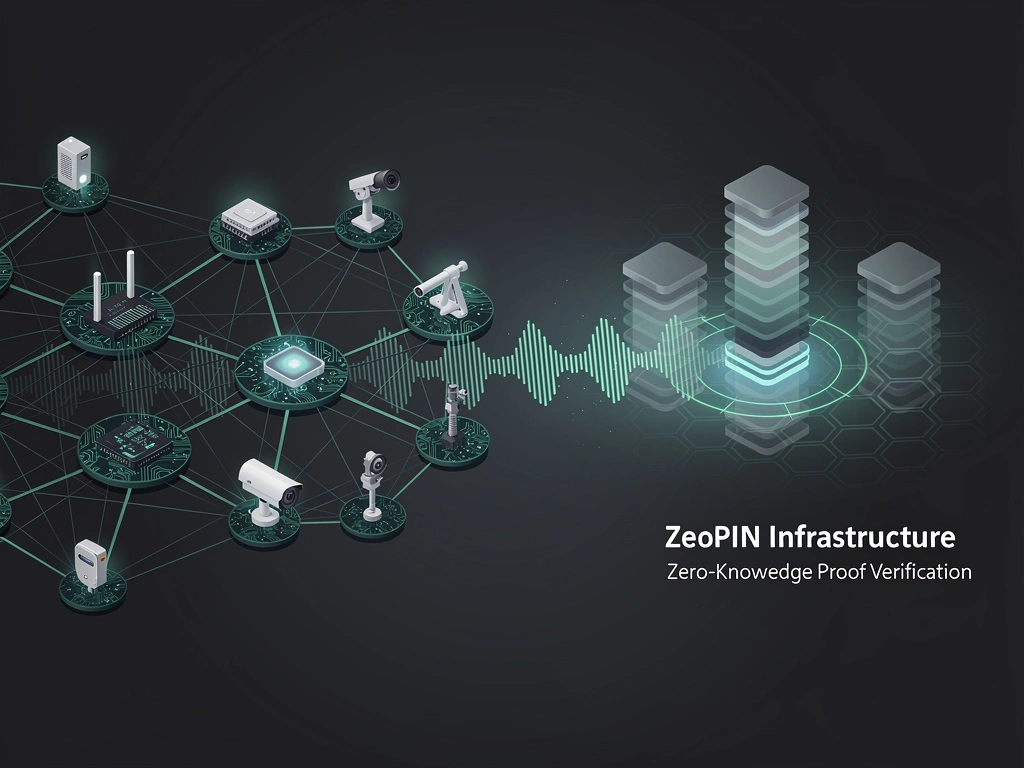
- W3bstream: off-chain verifiable computation layer connecting smart devices to smart contracts using ZKZKZero Knowledge. A class of cryptographic proofs that let you prove something is true without revealing any of the underlying information. ZK lets a network verify a transaction without seeing the transaction's contents.Like proving you know the password to a safe by demonstrating you can open it, without ever saying the password out loud. The verifier learns that you know the password and nothing more.ZK in the glossary → proofs to verify device data without exposing raw data.
- QuickSilver: real-time AI interaction layer enabling AI agents to process verified DePIN data.
- DIMs (DePIN Infrastructure Modules): modular toolkit for DePIN builders covering data attestationAttestationA cryptographic proof that a piece of code is running on a specific hardware enclave in an unmodified state. Attestation lets remote users verify that a service is genuinely running what it claims to be running.Like a tamper-evident seal on a medicine bottle. The seal itself doesn't make the medicine safe, but it gives you a way to verify that nobody opened the bottle and swapped the contents before you bought it.Attestation in the glossary →, identity, stakingStakingLocking up a cryptocurrency to help secure a blockchain network, usually in exchange for rewards. The locked tokens act as a security deposit that can be taken away if the staker misbehaves.Like putting down a large rental deposit for an apartment. You get the money back if you behave, you earn interest while it's locked, and the landlord takes it if you trash the place.Staking in the glossary →, and coordination.
Founded in 2017 by Raullen Chai (CEO, PhD Electrical/Computer Engineering, University of Waterloo; former Senior Software Engineer at Google, Lead Crypto R&D at Uber), Qevan Guo (PhD AI/Computer Vision, NUS; former product lead at Facebook), Jing Sun (founding partner, Sparkland Capital), and Xinxin Fan (PhD Waterloo; former Senior Research Engineer at Bosch). All founders are doxxed with verified credentials.
The entity structure is dual: MachineFi Inc (Houston, Texas) handles operations, and the IoTeX Foundation (Singapore) handles governance. Total funding approximately $70M: ICOICOInitial Coin Offering. A token sale where a project sells tokens directly to the public, usually before any product exists. ICOs dominated 2017-2018 funding and are now mostly replaced by airdrops, IDOs, or fair launches.Like a company selling shares to the public before going public, except with no SEC oversight, no audited financials, and often no product at all. The 2017 ICO boom showed why those guardrails exist in traditional finance.ICO in the glossary → ($19.9M, February 2018 at $0.0083), undisclosed round ($50M, Borderless Capital-led, April 2024), and Animoca Brands strategic investment (August 2025, where Animoca also joined as a network validator and network partner).
Mainnet launched 22 April 2019. The project has operated continuously for over seven years. On 17 December 2025, IoTeX published a MiCA-compliant whitepaper for IOTX, enabling uniform regulatory treatment across all 27 EU member states. On 23 April 2026, IoTeX shipped Explorer v4, which exposes AI-readable JSON-LD data, an /llms.txt endpoint, and dedicated APIs for AI-agent crawling, a small but on-narrative move for an “AI-native DePIN” L1.
Value proposition
Device identity + ZK data
ioID NFT-based device ownership with W3C DIDs. W3bstream ZK proofs verify device data without exposing it.
Institutional on-ramps
MiCA-compliant whitepaper, CF Benchmarks pricing index, HashKey IOTX/HKD pair, PayPal and Venmo fiat access.
ioTube bridge exploit
$4.4M stolen February 2026 after a compromised validator contract owner on Ethereum. Bridge suspended.
The only L1 blockchain purpose-built for DePIN with integrated device identity, data verification, and AI infrastructure. That is a clear architectural differentiator.
ioID and W3bstream: device sovereignty at the protocol level
ioID is the standout innovation: NFT-based on-chain ownership of physical devices with W3C DID/VCVCVenture Capital. Private investors who fund projects at an early stage in exchange for equity or token allocations. VC rounds are typically pre-launch, at steep discounts to any future public price, with multi-year vesting.Like angel investors in a startup who buy shares before the company goes public. They take more risk because the company might fail, so they get a better price. Once the company IPOs they can sell, and the public market pays whatever price it thinks is fair.VC in the glossary → standards, a rare combination in DePIN. When you register a device, an ioID NFTNFTNon-Fungible Token. A unique blockchain-tracked asset where each token is distinguishable from every other. Where regular tokens are interchangeable, NFTs represent unique items like art, collectibles, in-game assets, or domain names.Like the difference between a $20 note and a signed first-edition novel. The notes are interchangeable, any $20 buys the same thing as any other. The book is one of a kind, and its value depends entirely on which specific book it is.NFT in the glossary → is minted, and you provably own the device on-chain and control its data and rewards. This is device-level data sovereignty implemented at the protocol level, not as an application layer.
W3bstream adds ZK verification for device data. Devices generate data off-chain, W3bstream computes ZK proofs verifying that data meets specific conditions, and the proofs are submitted on-chain. The raw data never touches the blockchain; only the verified proof. This is the right architecture for IoT scale.
Adoption signals and the institutional bet
The metrics tell a mixed story. Our sample of 1,500 blocks across 7 October 2026 finds about 7,000 user transactions a day, far below the 250,000 daily transactions and 8,900 daily active wallets Messari reported for Q1 2025, and IoTeX counts 218 projects including 51 DePIN-specific applications. DePINscan (built by IoTeX) tracks 280+ DePIN projects and 18M+ devices across the broader DePIN space. IoTeX reports QuickSilver AI usage surged 43% in June 2025 and hit 3,000+ daily AI agent queries by late 2025. Protocol revenue reached $110K in Q3 2025, up 16% quarter-on-quarter (per IoTeX’s own reporting). Measurable numbers, but still negligible at scale.
In October 2025, IoTeX launched the Real-World AI Foundry at Token2049 Singapore, an open network for building Real-World Models (RWMs) trained on verified, live data from machines and sensors. Founding partners include Vodafone, Filecoin, Theta Network, Aethir, HashKey Chain, and 20+ others. This is IoTeX’s most significant strategic play to date, positioning the chain as the data verification layer for decentralised AIDeAIDecentralised AI. An umbrella term for blockchain-based projects that build AI infrastructure (compute, data, inference, models, agents) without a single central provider controlling the system.Like the difference between streaming a movie from Netflix and sharing it via BitTorrent. Netflix is fast and polished but one company controls what you can watch and what you pay. BitTorrent is messier but no single operator can shut you out.DeAI in the glossary → trainingTrainingThe one-time process of teaching a neural network to perform a task by showing it massive amounts of example data and adjusting its internal weights until the outputs are good. Training builds the model; inference uses it.Like the years an apprentice spends learning a trade. You don't see any of the actual work, just thousands of repeated mistakes gradually becoming competence. By the end, the apprentice can do the job. The training was invisible, but the skill is now permanent.Training in the glossary →.
The HashKey partnership (August 2025) established Hong Kong’s first AI Ecosystem Center with an IOTX/HKD trading pair on HashKey Exchange, a licensed, regulated venue. CF Benchmarks launched the IOTXUSD_RTI institutional pricing index, opening eligibility for ETFs and derivative products. These are substantive institutional on-ramps that go well beyond ordinary exchange listings.
The counter-narrative: TVL gap, bridge exploit, and pivots
The counter-narrative: ~$2M TVLTVLTotal Value Locked. The sum of all assets currently deposited in a protocol's smart contracts. TVL is the standard measure of how much capital a DeFi or DeAI protocol is custodying.Like the assets under management of a hedge fund. AUM tells you how much money the fund has been trusted with, which is a rough proxy for how much business it's doing. TVL plays the same role for crypto protocols.TVL in the glossary → after seven years and $70M+ in funding (DeFiLlama, 7-day median, 24 September 2026). Same adoption gap that plagues many infrastructure projects. The technology is sound (ZK-verified device data, self-sovereign device identity, high-performance EVM chain) but the market hasn’t rewarded it. The tokenTokenA digital unit of value or access rights tracked on a blockchain. Tokens can represent ownership in a project, a right to use a service, a share of future revenue, or simply a tradable asset with no underlying claim.Like a physical poker chip a casino issues. The chip itself has no value. What makes it worth something is what it lets you do at the casino, what the casino has promised, and how much other people will pay you for it.Token in the glossary → is down roughly 99% from its ATHATHAll-Time High. The highest price a token has ever reached. ATH is usually quoted as a reference point for how far the current price has fallen (or risen) since the peak.Like the record lap time on a racetrack. It tells you what the car has been capable of at its absolute best, not what it will do today. Whether that record gets broken again depends on conditions that may or may not come back.ATH in the glossary → of $0.2556 (November 2021).
Critical incident: On 21 February 2026, the ioTube bridgeBridgeA protocol that lets you move assets from one blockchain to another. Bridges typically lock the asset on the source chain and mint a wrapped version on the destination chain. Bridges are notoriously the most-attacked component in crypto.Like a coat check at a club. You hand over your coat, get a numbered ticket, and the club promises to return the coat when you bring back the ticket. The trust assumption is that the coat check doesn't lose your coat or run away with it.Bridge in the glossary → was exploited for approximately $4.4M after the validator contract owner account on Ethereum was compromised. The attacker minted 410M unauthorised CIOTX tokens and drained bridge reserves. IoTeX responded with a tiered compensation plan (100% for losses under $10K; staged quarterly payments above $10K with a 10% IOTX bonus). 86% of minted CIOTX was frozen via chain-level controls. The bridge remains suspended pending independent security audits. This is a material security event that undermines trust, though the Foundation’s compensation response was swift and structured.
The narrative has shifted multiple times: IoT (2018) → MachineFi (2022) → DePIN (2023) → DePIN x AI (2025) → Edge AI (2026). Each pivot builds on the previous one, but the pattern persists. The 2026 mandate is “All in on Edge AI, physically manifested intelligence.”
For the sovereignty thesis, IoTeX’s data sovereignty architecture remains among the strongest in DePIN. ioID with DID/VC standards, W3bstream ZK proofs, device keys stored on-device. This is among the best implementations of device-level data sovereignty in crypto. The founder personally committing code through March 2026 signals serious technical commitment.
Tokenomics
IoTeX states a maximum supply of 10 billion IOTX, and effectively all of it now circulates. VestingVestingA schedule that locks up tokens allocated to insiders, investors, and team members, releasing them gradually over months or years. Vesting prevents insiders from dumping on public buyers immediately after launch.Like a new employee's stock options at a startup. You don't get all the shares on day one. They unlock over four years so you stick around and do the work rather than cashing out and leaving.Vesting in the glossary → is complete, so no locked supply is left to price in.
IOTX also survives in its 2018 form, as an ERC-20 on Ethereum. On 12 October 2026 IoTeX opened a Redemption Portal that it says swaps the legacy token for native IOTX at 1:1 with no fees, paid to the same address. Holders send the ERC-20 to a deposit address and sign a message, then IoTeX credits the native coin. Our Ethereum RPC read on 13 October finds no contract code at that deposit address, so the swap rests on IoTeX’s own crediting. The ERC-20’s total supply still equals the full original mint, so redeemed tokens are held rather than burned.
Initial distribution: Ecosystem Fund (30%), Foundation (25%), Private Sale/Investors (24%), Team (15%), Community Rewards (6%). Combined insider allocation (Team + Foundation) was 40%. The ICO raised $19.9M at $0.0083 per IOTX in February 2018.
Multiple burnBurnPermanently removing tokens from circulation by sending them to an address that no one controls. Burns reduce total supply, which (all else equal) makes each remaining token worth more of the network's value.Like a company buying back its own shares and shredding them. The company's total value stays the same, but each remaining share now represents a slightly bigger slice of that value.Burn in the glossary → mechanisms exist. Burn-Drop allocated 1 billion IOTX to be burned as the first 1 million devices onboard: 900M burned, 100M airdropped to long-term stakers. Approximately 400 million IOTX (~4% of supply) has been burned to date. IoTeX 2.0 introduces EIP-1559-style gas feeGasThe fee paid to a blockchain to process a transaction. Gas is denominated in the chain's native token and varies with network demand. Sending a transaction without enough gas means the transaction fails and the gas is still consumed.Like the petrol that powers a car. You need to put petrol in to make the engine run. The amount of petrol you need depends on how far you're driving and how much you're carrying. If you run out, the car stops.Gas in the glossary → burning and ioID device registration burns.
IoTeX 2.0 tokenomics introduces new inflationary staking rewards counterbalanced by these burn mechanisms. The net supply effect depends on community governance votes. If staking emissions exceed burn rate, supply inflates. This creates uncertainty.
IOTX is used for gas fees, staking/delegation (4-11% APY depending on delegate), governance voting on IIPs (IoTeX Improvement Proposals), and ioID device registration (which burns IOTX). IIP-50 proposes validator slashing for underperformance, but it’s still a Draft in IoTeX’s IIP repository.
FDVFDVFully Diluted Valuation. The market cap a token would have if every token that will ever exist were already in circulation. FDV is what the project would be worth if all locked, vesting, or unminted tokens were trading today.Like valuing a startup based on what every share would be worth if all the unvested employee options had already been exercised. The number is bigger and uglier than the official market cap, but it tells you the true ceiling.FDV in the glossary →/MCap ratio near 1.0x, with effectively all supply circulating. Listed on Binance, KuCoin, Gate.io, MEXC, and HashKey Exchange (IOTX/HKD); Kraken lists no IOTX pair and Robinhood doesn’t appear in CoinGecko’s ticker set. Coinbase said on 24 August 2026 that it would suspend IOTX trading on 23 September 2026 following a listing-standards review, and its last reported trade was on that day. CF Benchmarks IOTXUSD_RTI institutional pricing index live. PayPal and Venmo fiat on-ramps available. MiCA-compliant whitepaper (December 2025) enables uniform listing across EU-regulated platforms.
ICO investors are underwater after eight years of holding.
How to participate
Stake IOTX. Delegate to any of the 69 active candidates (staking protocol, 4 October 2026) via the IoTeX staking portal. 4-11% APY depending on delegate chosen. Auto-stake for 91+ days to qualify for Burn-Drop airdrops. No minimum stake. Technical skill: basic.
Run a Delegate Node. The top 36 candidates by votes form the pool, from which a 24-member committee is drawn by VRF to produce blocks. Earn block rewardsEmissionsNew tokens created and distributed by a blockchain protocol over time as rewards to validators, stakers, or miners. Emissions fund network security and participation at the cost of diluting existing holders.Like a company that pays employees partly in newly printed shares. Every year the total number of shares goes up, which means existing shareholders own a slightly smaller slice of the same company unless the company grows faster than the printing.Emissions in the glossary → (4 IOTX per block) plus delegator fees. Must attract sufficient stake delegation. Technical skill: advanced.
Build DePIN Applications. Use DIMs (ioID, W3bstream, QuickSilver) to build DePIN apps. EVM-compatible, so deploy Solidity contracts. Hardware SDKs for Arduino, ESP32, Raspberry Pi. Halo Grants programme available. Technical skill: intermediate.
Honest assessment
Freedom Score: 60/100
IoTeX has verifiable data sovereignty innovations with ioID and W3bstream. The 123 delegates previously credited here are registrations: 69 meet the self-stake to be active, and 36 of those form the block-producing pool. The IIPs credited alongside it do not hold up either: IIP-42 and IIP-50 are both Drafts in IoTeX’s own repository and neither went to a vote. The ioTube bridge exploit is a security concern but doesn’t affect the core protocol’s decentralisation posture.
Infrastructure Decentralisation: 12/20. Own L1 with Roll-DPoS consensus. The staking protocol lists 123 registered candidates, 69 of them with the 1M IOTX self-stake to be active; the top 36 by votes form the pool, a 24-member committee is drawn from it per epoch via VRF, and nine delegates by vote weight exceed a third (read 4 October 2026). Block time measures about 2.5 seconds, so the throughput work has landed on chain even though IIP-42 itself is still a Draft. Permissionless node operation. Animoca Brands joined as a validator (August 2025). The 123-validator count earlier versions of this review credited is a registration count, and a 24-member committee drawn from a 36-seat pool still concentrates block productionBlockA batch of transactions added to a blockchain at a set interval. Each block cryptographically links to the previous one, creating an append-only chain that can't be rewritten without redoing all the work since.Like a page in a ledger. Every page has a fixed number of entries, every page references the previous page, and once a page is filled and signed off it can't be edited without visibly invalidating every page that came after. The chain is just a very long series of these sealed pages.Block in the glossary →. The Foundation steers protocol upgrades. Mainnet has operated continuously since April 2019. On the producing set this is permissionless operation with some centralisation vectors, the 9-12 band’s wording, so the score drops to the top of that band.
Governance Decentralisation: 8/20. The IIP process runs on Snapshot, and it has not held a vote since IIP-40 on 28 October 2024. Seventeen proposals sit in the space and the newest is nearly two years old, so the cadence this review previously called accelerating had already stopped when we described it. IIP-42 never appeared there and reads Status: Draft in IoTeX’s own repository; IIP-50 is a Draft too, and IIP-54 does not exist in it. Authoring an IIP and ratifying one are separate acts, and only the first is still happening. Turnout was thinning well before the silence: 485 votes in October 2021 against 140 on the last proposal. Foundation and MachineFi Lab retain implementation control, and governance is off-chain in a venue that has stopped voting.
The next protocol change follows the same path. iotex-core v2.5.0, a required release, carries the Zanzibar hard fork that switches on IIP-59: voter rewards computed and paid by the protocol at era boundaries, replacing the off-chain Hermes service (release note). It activated at block 53,533,081 on 19 October 2026, postponed from 53,155,801 (IoTeXScan hard-fork history). IIP-59 still reads Status: Draft, and Snapshot shows no vote on it.
Token Distribution Fairness: 7/15. Team (15%) + Foundation (25%) = 40% insider allocation. ICO was public at $0.0083. Effectively all supply now circulating; vesting largely complete. Burn-Drop has burned ~400M IOTX (4%). Initial allocation was heavy but matured supply profile.
Censorship Resistance: 9/15. Permissionless EVM-compatible chain. No KYC for transacting. Roll-DPoS with a 24-member committee drawn by VRF from the delegate pool each epoch resists casual censorship. IIP-50 slashing is still a Draft, so it can’t be credited as a deterrent. With 24 committee members at any given time, and nine delegates by vote weight holding over a third, the active set is small enough that coordinated censorship remains a non-trivial risk. That is the 7-9 band’s wording, so the score sits at its top rather than in the band above.
Data Sovereignty: 12/15. Core design principle and strongest dimension. ioID gives devices self-sovereign identity via W3C DIDs/VCs as NFTs. W3bstream ZK proofs verify device data without exposing raw data. Device keys stored on-device. The Real-World AI Foundry’s founding principles explicitly mandate open, verified data governance, reinforcing the sovereignty architecture. Strong data sovereignty implementation for DePIN, though production-scale verification of these guarantees across third-party hardware remains limited.
Open Source Transparency: 12/15. Apache-2.0 licence. 173 public repos, 3,598 commits, about 1,600 stars on iotex-core. Founder Raullen Chai personally committing code March 2026. IoTeX reports a CertiK audit (no vulnerabilities, formal verification). IIP process public. The ioTube bridge exploit (February 2026) revealed that the bridge validator contract owner account was a single point of failure, an operational security gap, though the bridge is peripheral infrastructure rather than core protocol. Bridge suspended pending independent audits.
Returns Score: 49/100
Token Utility: 14/20. IOTX is used for gas, staking/delegation, governance, and ioID device registration (burned). Multiple utility vectors, but gas usage remains minimal with ~$2M TVL. The utility design is strong but the volume isn’t there yet.
Value Accrual: 7/20. Burn-Drop has removed ~400M IOTX (4% of supply). EIP-1559 gas burning and ioID registration burns active under IoTeX 2.0. IoTeX reports protocol revenue of $110K in Q3 2025 (+16% QoQ), measurable but tiny. The Real-World AI Foundry (Vodafone, Filecoin, Theta, 20+ partners) may drive future data verification fees. With ~$2M TVL the actual value being captured remains minimal, but the accrual mechanisms are now live rather than planned. Upgraded from 6 to 7.
Supply Dynamics: 12/20. Effectively all of the 10B max supply already circulating, with minimal future dilution. FDV/MCap ratio near 1.0x is excellent. Burn-Drop deflationary. However, IoTeX 2.0 introduces new inflationary staking rewards. Net effect depends on community governance. If emissions exceed burns, supply inflates.
Revenue Sustainability: 5/25. Gas fees from about 7,000 daily user transactions (our October 2026 block sample), with fees kept minimal by design (IoT affordability). ~$2M TVL after 7+ years. IoTeX reports protocol revenue of $110K in Q3 2025, while DeFiLlama counts $91.7K of gross chain fees over the trailing year, which are chain fees rather than protocol revenue. Token Terminal also tracks its gas fees. The Real-World AI Foundry and Edge AI pivot may generate new revenue streams, but these are forward-looking. $70M funding provides runway but protocol-level sustainability remains weak.
LiquidityLiquidityHow easily a token can be bought or sold without moving the price. High liquidity means you can enter or exit large positions quickly at the quoted price. Low liquidity means even small trades can swing the market.Like the difference between selling a house and selling a share of Apple stock. The house might be worth more on paper, but finding a buyer at that price takes weeks. The Apple share converts to cash in one click.Liquidity in the glossary → & Access: 11/15. 50 tickers across 45 venues, with Binance, MEXC, Gate, KuCoin and HashKey Exchange (IOTX/HKD) all trading, plus PayPal and Venmo fiat on-ramps. CF Benchmarks IOTXUSD_RTI institutional pricing enables ETF and derivatives eligibility, and the MiCA-compliant whitepaper (December 2025) allows uniform listing across 27 EU member states. Coinbase suspended IOTX trading on 23 September 2026, as announced on 24 August, so the second of the two tier-1 venues this score rested on has left and Binance is the one that remains. The band’s “2+ tier-1 CEXs” clause no longer holds, which is what the point costs.
Quadrant: B (High Freedom, Low Returns)
IoTeX sits in Quadrant B: a sovereignty play with demonstrable technical differentiation but unproven commercial traction.
Key risks
- ioTube bridge exploit (February 2026). $4.4M stolen via compromised validator contract owner on Ethereum. Bridge suspended. Compensation plan issued, but the single-key vulnerability should never have existed on a chain that preaches device-level security.
- ~$2M TVL after 7+ years. The most damning metric. $70M+ in funding hasn’t driven meaningful on-chain adoption. TVL has barely moved in 12 months.
- ~99% from ATH. ICO investors are underwater after eight years. Long-term holders deeply in the red.
- IoTeX 2.0 inflationInflationThe annual rate at which new tokens are created and added to the circulating supply. Most networks use inflation to pay validators, stakers, and infrastructure providers from freshly minted tokens rather than real revenue.Like a landlord who raises the rent every year. If your salary goes up at the same rate, you break even. If it doesn't, you get poorer without noticing, because the number on your payslip hasn't changed but the ground under it has shifted.Inflation in the glossary → risk. New inflationary staking rewards may exceed burn rate, increasing supply.
- DePIN competition. peaq, Helium, and general-purpose L1s/L2s compete for DePIN projects.
- Governance has stopped voting. The Snapshot space that carries the IIP process has not put a proposal to token holders since October 2024.
- Narrative pivot fatigue. IoT → MachineFi → DePIN → DePIN x AI → Edge AI. Five pivots in eight years.
- Foundation concentration. MachineFi Lab and IoTeX Foundation retain significant influence despite decentralisation claims.
Score change log
| Date | Score | Change | Reason |
|---|---|---|---|
| 2026-10-20 | Data | N/A | Zanzibar activated at block 53,533,081 on 19 October 2026, so IIP-59 voter rewards now run on chain while IIP-59 is still a Draft and Snapshot’s last vote is IIP-40 (October 2024). Scores unchanged. |
| 2026-10-13 | Data | N/A | Recorded the IOTX Redemption Portal (12 Oct 2026), which IoTeX says converts legacy ERC-20 IOTX to native 1:1 with no fees; its deposit address holds no contract code, so crediting is off-chain. Scores unchanged. |
| 2026-10-07 | Data | N/A | ”No Token Terminal tracking” corrected: Token Terminal lists IoTeX with a fees metric (read 7 October 2026). Scores unchanged. |
| 2026-10-07 | Data | N/A | Daily transactions re-measured: a 1,500-block sample on 7 Oct 2026 finds about 7,000 user transactions a day (about 41,000 actions including per-block reward grants), against the 250,000 Messari reported for Q1 2025. Scores unchanged. |
| 2026-10-04 | Data | N/A | Candidate set read from the staking protocol: 123 registered, 69 with the self-stake to be active, a top-36 pool and a 24-seat committee. The “50 staked candidates” explorer figure behind the 24 Sep correction matches none of these sets. Scores unchanged. |
| 2026-10-04 | Data | N/A | Recorded the Zanzibar hard fork in iotex-core v2.5.0, which switches on IIP-59 on-chain voter rewards at block 53,533,081 (about 19 October) while IIP-59 is still a Draft with no vote. Scores unchanged. |
| 2026-09-25 | Freedom | Infrastructure 13 → 12, Censorship Resistance 10 → 9 (Freedom 62 → 60, C held) | The corrected 50-candidate, 24-seat set with a third of vote weight in nine delegates is a mid-band centralisation vector, and coordinated censorship stays a non-trivial risk while IIP-50 slashing is a Draft. |
| 2026-09-24 | Data | N/A | TVL ~$1.2M to ~$2M (DeFiLlama); validator set corrected to 50 staked candidates with a 24-seat committee (was 123 validators, 36 consensus); IIP-50 slashing is a Draft; Kraken/Robinhood dropped; Coinbase suspension now past; $110K revenue attributed. Scores unchanged. |
| 2026-09-23 | Data | N/A | Consensus wording aligned with IoTeX’s docs: a 24-member committee drawn from a pool of at least 36 delegates. Scores unchanged. |
| 2026-09-23 | Data | N/A | Integrity records re-cut: 3 claims now quote IoTeX’s own pages verbatim and 5 are our own measurements. Scores unchanged. |
| 2026-09-07 | Both | Liquidity & Access 12 → 11 (Returns 50 → 49, D held), Governance 10 → 8 (Freedom 64 → 62, C held) | Executes the September review’s deferred liquidity proposal: Coinbase suspends IOTX on 23 September so the “2+ tier-1 CEXs” clause fails. Governance drops to the 5-8 band, the Snapshot venue having not voted since October 2024. |
| 2026-09-06 | Data | N/A | WS3b governance rail: the IIP process has not put a proposal to a Snapshot vote since IIP-40 in October 2024, and IIP-42, cited across four surfaces as passed, reads Status: Draft in IoTeX’s own repository. Block time measures about 2.5 seconds, so the throughput landed without a ratifying vote. Governance 10/20 flagged for October. |
| 2026-09-06 | Data | N/A | Research JSON resynced to the frontmatter Returns breakdown. Value Accrual 6 and Liquidity & Access 9 in the JSON were the values the 2026-03-12 Returns 46 to 50 move superseded. No published score changed. |
| 2026-09-05 | Data | N/A | Coinbase announced on 24 Aug 2026 that it suspends IOTX trading on 23 Sep 2026 after a listing-standards review, read first-hand from the @CoinbaseMarkets post. Removed from the venue lists in the evidence string and the Liquidity section. Liquidity & Access 12/15 is a downgrade candidate once the suspension takes effect. |
| 2026-08-15 | Data | N/A | Circulating supply bound to the live source. The strip asserted 100% where CoinGecko reads 94.41% of max; prose moved to “effectively all supply”. |
| 2026-08-15 | Data | N/A | Circulating supply de-hardcoded into the live <CirculatingSupply /> component, and the stale percentage corrected from 94.4% to effectively 100% (CoinGecko). Removes the last of the vesting-overhang framing. No score change. |
| 2026-08-10 | Data | N/A | WS3 coldstart run added two grounded verdicts: supply_dynamics (10B / 94.4% circulating vs CoinGecko, match, api) and open_source_transparency (iotex-core Apache-2.0 + active, match, api). The bundle’s Ethereum-contract facts (top-10 81.72%, pausable) are the ioTube-bridged ERC-20, not IoTeX L1, so category-excluded. No score change. |
| 2026-06-26 | Data | N/A | DefiLlama LlamaAI harvest cross-check, verified independently (api.llama.fi + CoinGecko). Chain TVL has roughly halved to ~$1.2M (DefiLlama, from the $2.5M cited across the piece), sharpening the adoption-gap thesis; refreshed every instance. ATH decline refreshed to ~99% (verified -98.9% from $0.2556) and the ATH date corrected to November 2021 (the TokenFactsStrip had it as “Since 2018”, which is the ICO year, not the all-time high). Circulating 94.4% (~9.44B of 10B) and FDV-equal-to-market-cap both confirmed. No score change. |
| 2026-05-02 | Editorial | N/A | Added Explorer v4 launch (23 April 2026): AI-readable JSON-LD, /llms.txt, and AI-agent crawl APIs. No score change. |
| 2026-04-09 | Freedom | 70 → 64 | Cross-project score-consistency pass: recalibrated the March staleness-audit bump to the shared rubric. Infrastructure 15→13, Governance 12→10, Censorship 11→10, Data Sovereignty 13→12. |
| 2026-03-12 | Freedom | 60 → 70 | Validator set doubled (60→123), IIP-42 throughput upgrade, governance acceleration. Infrastructure 13→15, Governance 10→12, Censorship 10→11, Data Sovereignty 12→13. |
| 2026-03-12 | Returns | 46 → 50 | EIP-1559 burns live, HashKey exchange listing, CF Benchmarks index, MiCA whitepaper. Value Accrual 6→7, Liquidity 9→12. |
| 2025-03-06 | Both | N/A | Initial publish. Freedom 60/100, Returns 46/100. |
Team overview
PhD Electrical/Computer Engineering, University of Waterloo (cryptography). Former Senior Software Engineer/Tech Lead at Google, Lead Crypto R&D at Uber.
LinkedInPhD AI/Computer Vision, NUS. Former product lead at Facebook (Ads, Pages, Offers).
Founding partner Sparkland Capital. 40+ investments in security, blockchain, IoT.
PhD University of Waterloo. Former Senior Research Engineer at Bosch R&D.
| Round | Amount | Date | Lead |
|---|---|---|---|
| ico | $19.9M | 2018-02-15 | -- |
| undisclosed | $50.0M | 2024-04-02 | Borderless Capital |
| strategic | -- | 2025-08-27 | Animoca Brands |
Source: OYM Research · Last updated 2026-10-19
Technical snapshot
EVM-compatible L1 with Roll-DPoS consensus (DPoS + PBFT + VRFs). A delegate pool of the top 36 candidates by votes (123 registered, 69 with the self-stake to be active, staking protocol read 2026-10-04), with a 24-member committee drawn each epoch by VRF. 2.5s block time, 1-block finality, 1000 TPS. Core stack: IoTeX L1, ioID (device identity via DIDs/VCs as NFTs), W3bstream (ZK-verified device data), QuickSilver (AI agent framework), DIMs (modular DePIN tooling).
Commit Activity
Community
Audits
Scope: IOTX token and Delegates Program
No vulnerabilities found. Formal verification completed.
Source: OYM Research · Last updated 2026-10-19
Tokenomics deep dive
Token utility
- Gas fees on IoTeX L1
- Staking and delegation to validators
- Governance voting (IIPs)
- ioID device registration (burned)
- Burn-Drop mechanism tied to device onboarding
Source: OYM Research · Last updated 2026-10-19
IOTX Supply Simulator
Scenario Parameters
Circulating Supply Projection
Monthly Emissions vs Burns
Supply projections only. Token price held constant at $0.0040 (snapshot 19 Oct 2026). Burn-Drop: ~400M IOTX burned historically (4% of supply). Ongoing EIP-1559 gas burn + ioID registration burns route protocol fees into burns. This is not financial advice.
Participation at a glance
Stake IOTX to delegates. 69 active candidates of 123 registered (staking protocol, 2026-10-04) with varying reward policies. Auto-stake 91+ days for Burn-Drop airdrops.
Run an IoTeX delegate node. Candidates enter a pool (at least 36 per IoTeX's docs), from which a 24-member committee is drawn by VRF each epoch to produce blocks.
Build DePIN apps using DIMs (ioID, W3bstream, QuickSilver). EVM-compatible Solidity. IoT hardware SDKs.
Vote on IIPs via Snapshot. Any IOTX holder can vote.
Source: OYM Research · Last updated 2026-10-19
Usage and traction
Data from: DeFiLlama, Messari Q1 2025; our own block sample via babel-api.mainnet.iotex.io (2026-10-07); member.iotex.io delegate count (2026-10-07) (2026-10-07) . Cards dated separately are live readings (DeFiLlama chain TVL).
Research note, 2026-10-07: 3,010 ioID device owners. 218 ecosystem projects including 51 DePIN. DePINscan tracks 280+ DePIN projects globally. Re-read 2026-10-07. daily_transactions is our own estimate: 1,500 blocks sampled evenly across the 24 hours to block 53,128,021 (about 34,318 blocks a day) held 305 user transactions plus 1,506 system actions (the per-block reward grant to 0xa576...06be), so about 7,000 user transactions a day and about 41,000 actions including the reward grants, against the 250,000 Messari reported for Q1 2025. No keyless source for unique daily wallets was found (the analytics API needs auth), so that card is empty. The stored 50 validators matches none of the sets in the 4 October 2026 staking-protocol read (123 registered, 69 eligible, a top-36 pool, a 24-seat committee; iotex.mdx score log), and member.iotex.io still shows 123 delegates on 7 October, so the single-number validators card is empty.
Source: OYM Research · Last updated 2026-10-19
Community
Source: OYM Research · Last updated 2026-10-19
Read next
Project review
peaq
Independent peaq review: the DePIN Layer-1 for machines, PEAQ tokenomics, enterprise pilots, and why the chain earns almost nothing in fees.
Project review
Auki Review
Hong Kong spatial-computing DePIN with one externally documented retail pilot and an admitted-centralisation posemesh. Daily linear vesting is the cleanest piece. Reconstruction node network in closed beta. The 40,000-stores headline that surfaced in DeAI triage is wrong.
Project review
Ora Protocol
The verifiable AI oracle stopped answering in September 2025 and the team repointed the Ora name at an AI trading-fund product that does not use the token. The contract is immutable and admin-free. Nothing else is running.