Grass
Bandwidth-sharing DePIN network that claims 8.5M users. How to earn GRASS, tokenomics, and why 190-country scale doesn't mean decentralised.
Impressive scale and reported enterprise traction, but this is a centralised data business with a token incentive layer. Code is entirely closed-source, governance exists only in documentation, users contribute bandwidth without any sovereignty over the data produced, and the only revenue figures come from one commissioned review that carries no audit opinion. The widest airdrop in Solana history doesn't make a network decentralised.
- + Grass claims over 8.5M users across 190 countries, which would rank among the largest DePIN networks
- + Reported enterprise traction with ~20 AI customers; VALID dataset (CC-BY) and ClipTagger-12b are verifiable outputs
- + One of the widest airdrops in Solana history: 2.8M recipients, 10% of supply, no lockup
- − Zero public GitHub repos; every technical claim about ZK proofs and traffic separation is unverifiable
- − Revenue rests on one commissioned, unaudited review: no client names, no on-chain trail, no Foundation accounts
- − Users act as exit nodes with residential IPs; legal exposure from web scraping sits with contributors
Grass scores 37/100 (Grade F), reflecting a project with genuinely impressive distributed infrastructure at the node level (8.5M monthly active nodes by Grass's own unverified count) but fundamentally centralised control over data, revenue, validation, and governance. The network achieves remarkable scale -- millions of nodes across 190 countries contributing petabytes of data daily -- but the Grass Foundation and Wynd Labs control who accesses the data, how revenue flows, and all protocol decisions. Code is entirely closed-source (0 public repos).
Governance exists in documentation but not in practice. Users contribute bandwidth but have no sovereignty over the data produced or the value captured. The wide airdrop distribution (2.8M recipients) and permissionless node participation are genuine positives that prevent a lower score.
The 47.2% insider token allocation and team-controlled 22.8% Foundation allocation further concentrate control. This is a well-executed centralised data business with a token incentive layer and impressive community distribution, but it is not currently a decentralised network in any meaningful governance or data sovereignty sense.
Infrastructure decentralisation10/20
Grass reports 8.5M monthly active nodes across 190+ countries, which would rank among the largest DePIN networks by participant count; the figure is Grass's own and unverifiable (the app is login-gated, one centralised validator measures node counts, and the only on-chain population is the ~2.8M Airdrop One wallets). Nodes are permissionless (anyone can install the app and participate). However, significant centralisation vectors remain: (1) Validation is currently transitioning from a single centralised validator to a decentralised validator committee -- current state unclear; (2) Routers are operated by approved infrastructure providers, not permissionless; (3) Data storage centralised on Backblaze B2 (2-3 PB daily); (4) The Sovereign Data Rollup on Solana is planned but not confirmed live; (5) The core scraping coordination, client management, and data delivery are controlled by Wynd Labs / Grass Foundation. The network has permissionless participation at the edge (nodes) but centralised control at the core (validation, routing, storage, clients).
Governance decentralisation4/20
DAO governance is referenced in documentation with 22.8% of supply allocated to Foundation & Ecosystem Growth managed by DAO. However: no public governance proposals, no voting history, no governance forum found. All decisions currently made by Wynd Labs and the Grass Foundation. On the project's own description, customer revenue and contracting run through the Foundation; we have not independently verified the contracting arrangements. Token distribution gives the community 30% (airdrops + future incentives + router rewards) but 47.2% goes to investors and team, and the 22.8% Foundation allocation is team-controlled. This review found no instance of community governance being exercised.
Token distribution fairness7/15 Established
Airdrop One (10% of supply to 2.8M recipients with no lockup) was genuinely one of the widest token distributions in crypto history. Future Incentives (17%) and Router Rewards (3%) provide ongoing community allocation. Total community allocation: 30% (Airdrop One 10% + Future Incentives 17% + Router Rewards 3%). However, insider allocation is substantial: Early Investors 25.2% + Contributors 22% = 47.2%. Foundation 22.8% is team-controlled. The October 2025 cliff released ~181M investor tokens. No IDO or public sale -- funding came from VC rounds. The wide airdrop distribution partially offsets the heavy insider allocation.
Ten addresses hold just over half of GRASS supply, a quarter of it in one Squads-style multisig vault. The top ten hold 53.47% of supply and the shape is unusually legible for Solana. A single off-curve PDA holds 25.65%, which is a Squads-style vault: no private key exists for it, so it is a multisig treasury rather than a person. Three further positions totalling 13.92% sit under one unidentified program, which is the signature of a vesting or distribution contract though it is not established as one here. The remainder is six keypair wallets. Nine of the ten are unattributed to any named entity. Resolved each of the largest token accounts to its owner, then classified the owner on-chain rather than by label: System-owned and on-curve is a keypair wallet, System-owned and off-curve is a PDA with no private key (in practice a Squads-style vault), and a known pool program is neutral infrastructure. The rated figure is the RAW top-10 share. This is NOT the EVM ex-infra basis: exchange custody cannot be identified without labels and is therefore included, which is visible here rather than assumed.
Established The vault share is the useful half: a quarter of supply behind a multisig threshold is a different governance fact from a quarter in one wallet, and the curve test separates them without needing anyone to label the address. The three program-held positions are worth a human trace at the next review.
Censorship resistance6/15 Established
Users operate nodes permissionlessly and can contribute bandwidth from any residential connection. However: (1) Enterprise clients must go through a vetting process and sign service agreements -- the Foundation controls who can access the data; (2) Client activity is monitored and clients can be 'immediately banned for activity deemed sketchy'; (3) Staking contracts include manual multisig-controlled slashing capability; (4) The Grass Foundation acts as centralised intermediary between data contributors and data consumers; (5) Certain jurisdictions (sanctions, regulatory risk) are excluded from token eligibility; (6) Browser extension and apps can be removed from app stores. The network is resistant to censorship at the bandwidth contribution layer but the data consumption layer is fully controlled.
The GRASS mint has no freeze authority, so GRASS token accounts cannot be frozen. The GRASS SPL mint has freezeAuthority = NULL, so token accounts cannot be frozen. On the supply side the mint authority is live, held by a Squads multisig, so the centralisation risk is dilution rather than transfer-freezing. Manual SPL freeze-authority read via the coldstart Solana source. Ingestion only, verdict human-set.
Established A token-layer custody anchor, separate from the review score. The live mint authority is recorded on the supply_cap_enforcement row.
Data sovereignty5/15
Users contribute bandwidth but do not own or control the scraped data. Grass collects minimal personal data (email, username, password, IP address) and states it 'will never sell personal information.' Network traffic is separate from personal browsing. The ZK proof system creates data provenance records. However: (1) Scraped data is owned/controlled by the Grass Foundation and sold to enterprise clients; (2) Data is stored centrally on Backblaze B2; (3) Contributors have no control over what data is scraped through their connection; (4) Users act as exit nodes -- their IP addresses are used for scraping, exposing them to potential liability if clients scrape restricted content; (5) Despite privacy safeguards, the Foundation has full visibility into all scraped data. Users contribute the resource but have no sovereignty over the resulting data asset.
Open source transparency5/15 Established
Grass is substantially closed-source. Wynd-Network GitHub has 0 public repositories. GrassFoundation GitHub has 1 repo (GrassDownload, HTML). Node software, router software, validator software, ZK processor, and core protocol are all proprietary. The Cantina security competition (June 2024) reviewed three Solana program repositories (staking, token, airdrop) but these are not publicly accessible. On the positive side: (1) VALID dataset collaboration with LAION/Ontocord is open (CC-BY, 14TB); (2) ClipTagger-12b model is Apache-2.0; (3) AppEsteem certification provides third-party security monitoring; (4) Token contract is on-chain (Solana SPL) and verifiable; (5) Documentation is available via GitBook. Financial transparency is limited -- the first revenue figures arrived in September 2026 through a Grass-commissioned Regen Financial review with no audit opinion (S034); Foundation controls all funds and spending is undisclosed.
Grass's node software is closed: the Wynd-Network GitHub organisation has no public repositories and the node client is proprietary. Re-read 2026-09-18 through the GitHub API: github.com/Wynd-Network has 0 public repositories, and there is no separate public org at github.com/getgrass (404). The Grass node runs as a proprietary browser extension and desktop client with no published source, so the network client cannot be audited. Direct GitHub org enumeration. Ingestion only, verdict human-set.
Established Grass has not described its node software as open source. Any repository appearing in the org crosses the drift band.
Overall returns potential is moderate at 55/100. Strongest dimension: liquidity & access (12/15). Weakest: value accrual (8/20).
Token utility12/20
Token used for enterprise LCR product. Users earn via bandwidth sharing.
Value accrual8/20
Enterprise demand buys tokens. Revenue is now partly disclosed, but nothing on-chain ties it to the token.
Supply dynamics8/20 Established
1B cap. Team/investor allocation significant. Wide airdrop but insider heavy. 55M unlock Feb 2026.
GRASS supply sits at its 1 billion total, but a Squads multisig still holds mint authority, so the token itself does not enforce the cap. getTokenSupply on the GRASS SPL mint Grass7B4RdKfBCjTKgSqnXkqjwiGvQyFbuSCUJr3XXjs (9 decimals) = 999,993,124.25, against the 1B total. mintAuthority is set to 31rYartQwHeBMjAe2MgGpffGV57fQY3kug4BDN8tLGqQ, a Squads multisig vault: System-Program-owned with no data, off-curve (no private key can exist for it), and labelled 'Grass Multisig' with a #Squad Vault tag on Solscan. More GRASS can be minted beyond 1B, subject to the multisig's threshold. Manual SPL reads via the coldstart Solana source + authority owner-classification. Ingestion only, verdict human-set.
Established Grass's docs allocate 1B GRASS across four tranches (community, foundation and ecosystem, early investors, contributors) and do not describe the supply as fixed. Nothing has been minted above the total so far.
Revenue sustainability15/25 Editorial
A Grass-commissioned review puts booked revenue at $32.1M, $27.6M traced to cash (Mar 2025 to Jun 2026). No assurance given; we can't re-check it.
“This one-page summary sets out the Revenue reported by Grass DataCo Ltd. for the periods below, the amount of Revenue we have substantiated by tracing actual cash receipts, and a broad description of what makes up the difference between the two.” (2026-09-17) source →
No source we can check. The only third-party element is Regen's cash tracing: $27,590,879.72 substantiated by cash receipts (85.9% of booked), $4,523,608.80 not yet (78.1% for Period 2 against 92.3% for Period 1; the lower recent share is mostly timing, since Period 2 closed eleven weeks before the review and some contracts carry 60-day terms). We cannot re-perform it: revenue is off-chain enterprise contracts, customer names and receipts are unpublished, and the full findings report is 'available on request'. We checked only that the document's own tables sum exactly, which they do. Downloaded the summary PDF, extracted the tables, re-added every row and column (all reconcile to the cent), and compared the headline circulating on X against the document. No on-chain footprint exists for this revenue to reconcile against.
Editorial Grass commissioned and published the summary, which states it is 'not an audit, review, or other assurance engagement'. Nothing in it can be re-performed by an outsider. The strongest statement it supports is that Regen Financial traced $27.6M of Grass DataCo's booked $32.1M to cash receipts. See the revenue_attestation_scope flag.
Liquidity & access12/15 Established
Listed on Bybit, Gate.io, KuCoin, Kraken, Bitget, Bithumb, OKX (spot, April 2026) and Coinbase (spot, 26 August 2026). Binance Futures perpetuals. Strong retail access.
GRASS is listed on major exchanges including Coinbase, Kraken and OKX, but nearly half its reported volume sits on one little-known venue. Bybit, Gate, KuCoin, Kraken, Bitget, Bithumb and OKX all appear in the 67-ticker set across 54 venues. Coinbase is missing from CoinGecko's set, and Coinbase itself returns GRASS-USD as online. Depth is concentrated: Aivora Exchange carries $8,164,094 of $17.16M reported 24h volume, 47.6%, ahead of LBank at 21.0%, with Bybit third. Turnover is a 6.96% 7-day median. Paginated the CoinGecko ticker set, summed 24h volume per venue, then queried Coinbase directly for the venue that did not appear, since an aggregator gap is not a delisting.
Established The Coinbase listing was confirmed at the venue because CoinGecko's ticker set omits it. With nearly half the reported flow on one venue, turnover is a poor measure of depth.
Not financial advice. Scores are opinions, not recommendations. Crypto is high-risk – you could lose everything you invest. Full disclaimer.
Embed this rating

The badge updates automatically when the score changes.
On this page
Residential bandwidth, scraped data, Foundation-settled rewards
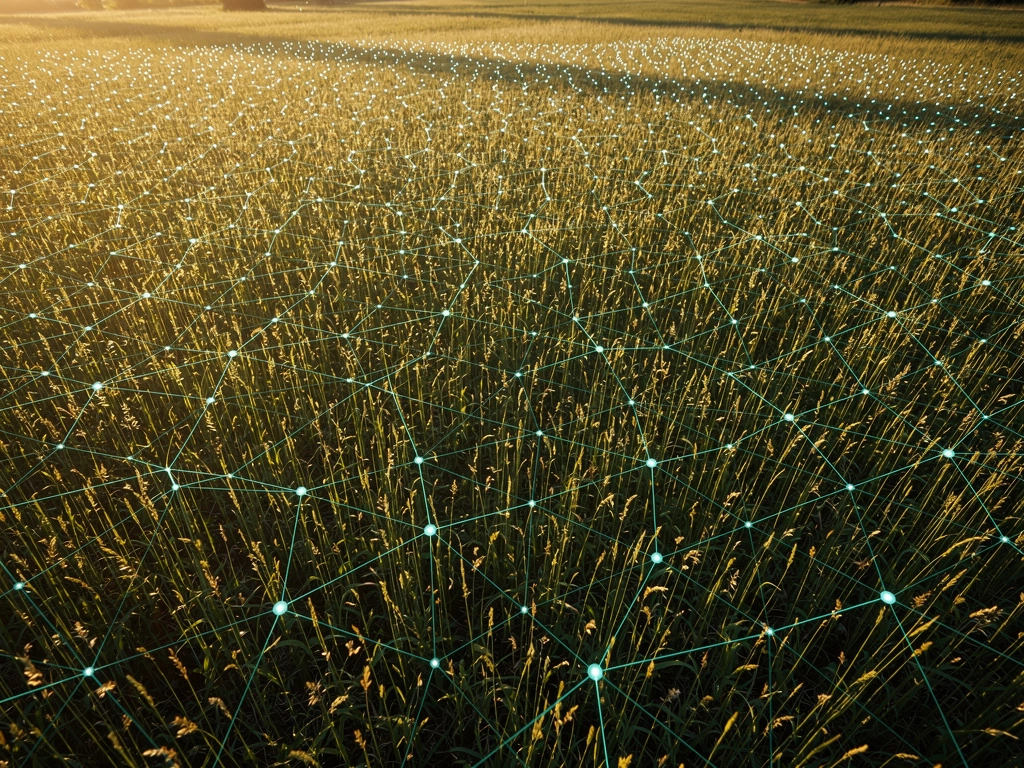
Bandwidth-sharing DePIN on Solana. Users contribute residential IPs via browser extension, mobile app or the Grasshopper hardware node; Wynd Labs routes web scraping through those IPs; AI customers pay (fiat or GRASS) for Live Context Retrieval and bulk training data; the Grass Foundation settles rewards back to nodes and routers in GRASS — the fiat-to-GRASS conversion is off-chain, not algorithmic.
What it does
Grass is a bandwidth-sharing network on Solana where users install a browser extension, desktop app, Android app, or the Grasshopper hardware device to contribute unused internet bandwidth to scrape public web data for AI trainingTrainingThe one-time process of teaching a neural network to perform a task by showing it massive amounts of example data and adjusting its internal weights until the outputs are good. Training builds the model; inference uses it.Like the years an apprentice spends learning a trade. You don't see any of the actual work, just thousands of repeated mistakes gradually becoming competence. By the end, the apprentice can do the job. The training was invisible, but the skill is now permanent.Training in the glossary →. The pitch is simple: you have spare bandwidth, AI companies need web data, Grass connects the two and you earn tokens. Grass claims over 8.5 million users across 190 countries, and reported retrieving 3 petabytes of data a day in September 2025.
The architecture has five layers. Grass Nodes are lightweight clients that relay web traffic using residential IP addresses, available as browser extensions, desktop apps, mobile apps, and since Q4 2025 the Grasshopper hardware device, a palm-sized aluminium box that plugs into your router via Ethernet and runs 24/7 without touching your personal devices. Routers are intermediary infrastructure connecting nodes to validators and managing network accountability. Validators process and verify web transactions, generating zero-knowledge proofs to checkpoint session data on-chain. A ZKZKZero Knowledge. A class of cryptographic proofs that let you prove something is true without revealing any of the underlying information. ZK lets a network verify a transaction without seeing the transaction's contents.Like proving you know the password to a safe by demonstrating you can open it, without ever saying the password out loud. The verifier learns that you know the password and nothing more.ZK in the glossary → Processor batches these proofs and submits them to Solana. Edge EmbeddingEmbeddingA numerical representation of a word, sentence, or image as a list of numbers (a vector) that captures its meaning. Similar things have similar embeddings, which makes them useful for search, clustering, and recommendation.Like a map where every word has GPS coordinates. Words with similar meanings end up close together on the map. "Cat" and "kitten" are nearby. "Cat" and "thunderstorm" are far apart. The map is the embedding space.Embedding in the glossary → Models convert the raw scraped data into structured formats suitable for AI training. A Sovereign Data RollupL2Layer 2. A blockchain that runs on top of an L1 to provide cheaper or faster transactions while inheriting the L1's security. L2s batch many transactions and post compressed proofs back to the L1.Like an express lane built on top of a busy motorway. The express lane handles its own traffic at high speed, but it still feeds back into the main motorway and uses the motorway's bridges and tolls for security.L2 in the glossary → on Solana is planned to provide verified data with full provenance tracking, though its operational status remains unclear despite being described as “launching soon” throughout 2024 and 2025.
Live Context Retrieval (LCR) is the enterprise product. When an AI modelModelA trained neural network that takes inputs (text, images, audio) and produces outputs (more text, classifications, generated content). In DeAI the model is the thing that actually does the work.Like a very experienced apprentice who has spent years watching thousands of masters make furniture. They can't explain how they know when a joint is right, but they can make a chair that looks and functions like a Chippendale. The training is invisible. The output is what matters.Model in the glossary → receives a promptPromptThe text you give an AI model to tell it what to generate. A prompt can be a simple question, a long instruction, a chunk of context plus a task, or a conversation history the model uses to produce its response.Like a brief you give to a junior designer. A vague brief gets a vague result. A detailed brief with context, constraints, and examples gets something usable. The quality of the output depends heavily on the quality of the brief.Prompt in the glossary →, Grass retrieves relevant current information from the web to supplement the prompt before it reaches the model. Every LCR call requires GRASS tokens; fiat payments are converted to GRASS.
Grass’s 28 September 2026 post, “Abundant Intelligence”, sets out a shift toward retrieval at inference time. It says a Contents API will let a model open and render any public webpage through the network’s residential connections, and that a Search API will follow once Grass has indexed enough of the public web, with multimodal grounding alongside. Grass opened the Contents API on 8 October 2026 behind an access request, adding JavaScript rendering, geo-targeting and freshness controls (Grass on X). The Search API and multimodal grounding are still described as coming.
The project was founded by Andrej Radonjic (CEO) and Chris Nguyen (CTO). Radonjic holds a Master’s in Mathematics and Statistics from York University and a Bachelor’s in Engineering Physics from McMaster. He was pursuing a PhD in computational physics before founding Wynd Labs during the pandemic. Nguyen is identified through a Backblaze case study and Wellfound but maintains a limited public profile. Radonjic is the most publicly identified team member. The operating entities are Wynd Labs (headquartered in Toronto, Canada; incorporation jurisdiction not publicly disclosed) and the Grass Foundation (a separate entity managing tokenTokenA digital unit of value or access rights tracked on a blockchain. Tokens can represent ownership in a project, a right to use a service, a share of future revenue, or simply a tradable asset with no underlying claim.Like a physical poker chip a casino issues. The chip itself has no value. What makes it worth something is what it lets you do at the casino, what the casino has promised, and how much other people will pay you for it.Token in the glossary → contracts and revenue). Team size is undisclosed.
The GRASS token launched on 28 October 2024 via AirdropAirdropDistributing tokens for free to eligible wallets, usually to reward early users, bootstrap a community, or decentralise token ownership away from a small group of insiders at launch.Like a supermarket handing out free samples to people who already shop there. The samples cost the supermarket nothing to print. The goal is to convert casual shoppers into loyal customers by giving them something tangible to talk about.Airdrop in the glossary → One, distributing 100 million tokens (10% of supply) to 2.8 million eligible wallets. No ICOICOInitial Coin Offering. A token sale where a project sells tokens directly to the public, usually before any product exists. ICOs dominated 2017-2018 funding and are now mostly replaced by airdrops, IDOs, or fair launches.Like a company selling shares to the public before going public, except with no SEC oversight, no audited financials, and often no product at all. The 2017 ICO boom showed why those guardrails exist in traditional finance.ICO in the glossary → or IDOIDOInitial DEX Offering. A token launch mechanism where the initial sale happens directly on a decentralised exchange, with built-in liquidity pool funding. IDOs replaced ICOs as the standard launch model for many projects after 2018.Like opening a new shop directly inside an existing market hall instead of running a separate sale event. The shop is open, the market provides foot traffic, and customers can walk in and trade from day one.IDO in the glossary → was held.
Value proposition
Widest airdrop in Solana history
10% of supply to 2.8M wallets with no lockup. 88% claimed; reachable with ~100 hours of uptime.
Reported enterprise revenue
$32.1M booked Mar 2025 to Jun 2026 per a Grass-commissioned review, $27.6M of it traced to cash. ~20 enterprise AI customers.
Zero open source
Wynd-Network GitHub has zero repos. Node, router, validator and ZK processor are all proprietary.
AI companies need vast quantities of web data, and millions of residential internet connections can provide it at scale, with better coverage and lower detection rates than data centre scraping. Residential IPs bypass bot detection and geo-restrictions that blockBlockA batch of transactions added to a blockchain at a set interval. Each block cryptographically links to the previous one, creating an append-only chain that can't be rewritten without redoing all the work since.Like a page in a ledger. Every page has a fixed number of entries, every page references the previous page, and once a page is filled and signed off it can't be edited without visibly invalidating every page that came after. The chain is just a very long series of these sealed pages.Block in the glossary → data centre connections, giving Grass a structural advantage in data collection. This is factually accurate.
Grass’s homepage claims over 8.5 million users (October 2026), and its last network update on X, in September 2025, reported 8.3 million users running a node in the prior 30 days, 1 million concurrent connections and 3 petabytes retrieved daily. Approximately 20 enterprise customers, described as including “the largest AI labs,” with “seven-figure revenue clients” (Grass’s own characterisation). The VALID dataset, a collaboration with LAION and Ontocord, produced 14 terabytes of multimodal data from 720,000 CC-BY YouTube videos (30 million audio snippets, 15 million images). ClipTagger-12b, a 12-billion parameter vision-language model built with InferenceInferenceRunning a trained AI model to produce an answer. Inference is what happens when you type a prompt into ChatGPT and get a response. The model takes your input, computes a best guess, and returns it.Like asking an expert for their opinion. The training was the decades they spent becoming an expert. The inference is the 30 seconds it takes them to answer your specific question.Inference in the glossary →.net, reportedly benchmarks favourably against GPT-4.1 and Claude 4 Sonnet at 15x lower cost. These are tangible outputs.
The airdrop was exceptionally wide. 2.8 million recipients received 10% of supply with no lockup. 88.36% was claimed by 2.06 million wallets. For context, most Solana airdrops reach a few hundred thousand addresses. Grass reached 2.8 million. The minimum threshold of 500 points (roughly 100 hours of uptime) was accessible to anyone with an internet connection.
Counter-narrative: “Decentralised data layer for AI” is the tagline, but the data layer is centralised. Wynd Labs and the Grass Foundation control all enterprise relationships, data storage (centralised on Backblaze B2, 2-3 petabytes uploaded daily), validation (transitioning from a single centralised validatorValidatorA computer that runs the full blockchain protocol, verifies transactions, and proposes new blocks. Validators are the workers that keep a Proof of Stake network running, and they earn rewards for doing the work correctly.Like a notary public who witnesses and stamps legal documents. Validators witness transactions, check they follow the rules, and stamp them into the permanent record. A notary who commits fraud loses their license. Validators work the same way, except the license is staked tokens that get slashed on misbehaviour.Validator in the glossary →), and revenue (customer contracts run through Grass DataCo, a Foundation subsidiary, and the only published figures come from one commissioned review). Users contribute bandwidth but have zero control over what is scraped, who buys the data, pricing, or protocol direction. Bandwidth rental, not data ownership.
Closed-source is the hardest problem. Wynd-Network’s GitHub organisation has zero public repositories. GrassFoundation has one repository (GrassDownload, an HTML page). Node software, router software, validator software, and the ZK processor are all proprietary. You can’t independently verify claims about zero-knowledge proofs, data handling, or network architecture.
Tokenomics
GRASS is an SPL token on Solana (contract: Grass7B4RdKfBCjTKgSqnXkqjwiGvQyFbuSCUJr3XXjs). Total supply: 1 billion, with mint authority still held by a Squads multisig, so the cap is policy rather than code. Circulating supplyCirculating SupplyThe number of tokens currently in circulation and tradeable on the open market. Differs from total supply (which includes locked or unvested tokens) and max supply (the upper limit, if there is one).Like the number of cars on the road today versus the number ever produced. Some are in showrooms, some in junkyards, some still at the factory. Only the ones on the road count toward what people are actually driving.Circulating Supply in the glossary → has been growing through 2025-2026 as vestingVestingA schedule that locks up tokens allocated to insiders, investors, and team members, releasing them gradually over months or years. Vesting prevents insiders from dumping on public buyers immediately after launch.Like a new employee's stock options at a startup. You don't get all the shares on day one. They unlock over four years so you stick around and do the work rather than cashing out and leaving.Vesting in the glossary → unlocks occur, with a significant 55 million token unlock to contributors on 28 February 2026. See live data above for current circulating figures.
Distribution:
- Early Investors: 25.2% (252M GRASS; 1-year cliffCliffA waiting period at the start of a token vesting schedule during which no tokens unlock at all. After the cliff ends, tokens begin releasing according to the vesting schedule.Like a probationary period at a new job. You don't get your stock options on day one. You wait 12 months to prove you'll stick around, then everything starts unlocking normally.Cliff in the glossary → reached October 2025, then linear over 12 months; approximately 39% unlocked as of March 2026)
- Foundation and Ecosystem Growth: 22.8% (228M GRASS; cliff period then linear over 60 months; managed by Grass Foundation; approximately 37% unlocked)
- Contributors (Team): 22% (220M GRASS; 1-year cliff reached October 2025, then linear over 36 months; approximately 14% unlocked)
- Future Incentives: 17% (170M GRASS; linear over 36 months, no cliff; originally allocated toward Season 2 incentives. Approximately 68% has unlocked on the emissions schedule. The Grass-native wallet launched on 23 July 2026 and Season 2 claims went live the same day, but those rewards are paid in USDC, not new GRASS emissions)
- Airdrop One: 10% (100M GRASS; 100% unlocked at TGETGEToken Generation Event. The moment a project's token first becomes tradeable. TGE is when vesting clocks usually start, when liquidity hits exchanges, and when public price discovery begins.Like the IPO day for a startup. Everything that happened before TGE was private valuations and paper agreements. Everything after is the public market deciding what the thing is worth in real time.TGE in the glossary →; distributed to 2.8M wallets; 88.36% claimed)
- Router Rewards: 3% (30M GRASS; linear over 30 months; approximately 55% unlocked)
The insider allocation is 47.2% (25.2% investors plus 22% team). The Foundation controls an additional 22.8%. Community allocation is 30% (10% Airdrop One plus 17% Future Incentives plus 3% Router Rewards). The October 2025 cliff released approximately 181 million investor tokens (50% of the investor allocation). A further 55 million tokens unlocked to contributors on 28 February 2026, representing approximately 13% of circulating supply at the time. Monthly linear unlocks continue across all categories through 2028-2029.
No burn mechanism exists. StakingStakingLocking up a cryptocurrency to help secure a blockchain network, usually in exchange for rewards. The locked tokens act as a security deposit that can be taken away if the staker misbehaves.Like putting down a large rental deposit for an apartment. You get the money back if you behave, you earn interest while it's locked, and the landlord takes it if you trash the place.Staking in the glossary → yields approximately 7.49% APR via delegation to routers per Stakin, a staking provider, with a 7-day unstaking period. Slashing is planned but not currently implemented; when it arrives, it will be manual and multisig-controlled.
Funding totals $14.5 million across four rounds: $1 million pre-seed (No Limit Holdings, July 2023), $3.5 million seed (Polychain Capital and Tribe Capital co-leads, December 2023), undisclosed Series A (HackVC lead, with Delphi, Brevan Howard Digital, Lattice, September 2024), and $10 million bridgeBridgeA protocol that lets you move assets from one blockchain to another. Bridges typically lock the asset on the source chain and mint a wrapped version on the destination chain. Bridges are notoriously the most-attacked component in crypto.Like a coat check at a club. You hand over your coat, get a numbered ticket, and the club promises to return the coat when you bring back the ticket. The trust assumption is that the coat check doesn't lose your coat or run away with it.Bridge in the glossary →/token purchase (Polychain and Tribe Capital, October 2025). Polychain Capital invested three times. On 29 September 2026 Multicoin Capital announced an investment in Grass from its hedge fund and venture fund, with no amount disclosed.
GRASS is spot-listed on Bybit, Gate.io, KuCoin, Kraken, Bitget, Bithumb, OKX (added 24 April 2026) and Coinbase (spot trading from 26 August 2026), with Binance Futures perpetual contracts (up to 75x leverage) adding derivatives liquidityLiquidityHow easily a token can be bought or sold without moving the price. High liquidity means you can enter or exit large positions quickly at the quoted price. Low liquidity means even small trades can swing the market.Like the difference between selling a house and selling a share of Apple stock. The house might be worth more on paper, but finding a buyer at that price takes weeks. The Apple share converts to cash in one click.Liquidity in the glossary →. The ATHATHAll-Time High. The highest price a token has ever reached. ATH is usually quoted as a reference point for how far the current price has fallen (or risen) since the peak.Like the record lap time on a racetrack. It tells you what the car has been capable of at its absolute best, not what it will do today. Whether that record gets broken again depends on conditions that may or may not come back.ATH in the glossary → of $3.89 was hit on 8 November 2024, just eleven days after launch. The token was about 89% below that peak on 24 September 2026 (CoinGecko). See live data above for current pricing.
How to participate
For the full step-by-step walkthrough and a realistic earnings picture, see How to Earn with Grass.
Run a Grass node. The most accessible entry point. Install the browser extension, desktop app, or Android app. The node passively shares unused bandwidth to scrape public web data. No staking, no technical knowledge. Earn Grass Points based on bandwidth contribution, uptime, and location. Points convert to GRASS tokens during airdrop distributions. Season 2 claims went live on 23 July 2026 through the newly launched Grass-native wallet, with those rewards paid in USDC. Requires a residential IP (data centre IPs are not eligible).
Buy a Grasshopper. For dedicated bandwidth sharing without tying up a computer or phone. Grasshopper is a palm-sized aluminium device that plugs into your router via Ethernet and runs 24/7 as a persistent node. FCC and ICES-003 certified, fully encrypted in transit, physically isolated from your home network. Handles only Grass traffic. No access to personal devices or data. Pricing not yet disclosed; announced with a waitlist in mid-2025, but shipping has been delayed by tariff-driven supply chain constraints and actual delivery status remains unclear.
Stake GRASS. Delegate tokens to router operators via grassfoundation.io/stake. Routers with more delegated stake receive more network traffic, generating higher rewards. Approximately 7.49% APR, per Stakin. No minimum stake. 7-day unstaking period.
Operate a router. Advanced participation. Routers relay bandwidth between nodes and validators. Earn rewards from the 30 million Router Rewards allocation plus commission on delegator rewards. Hardware requirements not publicly specified. Details limited.
Enterprise access. AI companies access Grass data through the Foundation. Approximately 20 current customers. Vetting process and service agreement required. Pricing not publicly disclosed.
Honest assessment
What works
The reported scale is large. Grass claims over 8.5 million users across 190 countries and last reported 8.3 million active nodes in September 2025, which would make it one of the largest DePINDePINDecentralised Physical Infrastructure Networks. Protocols that use token incentives to coordinate real-world physical infrastructure like GPU compute, wireless networks, storage, mapping sensors, or bandwidth.Like crowd-sourced ride-sharing but for physical hardware. Uber incentivises drivers with dollars. DePIN incentivises hardware operators with tokens. The network grows because individuals choose to contribute capacity in exchange for rewards.DePIN in the glossary → networks by participant count. No independent figure exists to check it against: the app is login-gated, one centralised validator measures node counts, and the only on-chain population is the 2.8 million wallets eligible for Airdrop One. Grass said in September 2025 that its 3 petabytes per day of data retrieval is driven by customer demand.
Enterprise traction now has a number on it. In September 2026 Grass published a review by Regen Financial covering every work order at Grass DataCo from 14 March 2025 to 30 June 2026: $32.1M booked, of which $27.6M (86%) was traced to cash receipts. Per the review, the rest is mostly timing: $2.7M not yet invoiced on long-term contracts and $1.8M invoiced but unpaid.
The VALID dataset collaboration with LAION and Ontocord produced a 14-terabyte open dataset (CC-BY) that demonstrates the data pipeline converts bandwidth into usable AI assets. ClipTagger-12b is a published model with Apache-2.0 licensing. These are verifiable outputs, not promises.
The airdrop model deserves credit. 2.8 million recipients receiving 10% of supply with no lockup is one of the widest distributions in Solana history. The 500-point minimum threshold meant anyone who ran the extension for roughly 100 hours could qualify. This created a credible base of millions of token holders, even if many were airdrop farmers.
Barrier to entry is near zero. Install an extension, earn tokens. No staking minimum, no technical skills. That is how Grass reached the 8.5 million participants it reports. The Android app (launched July 2025) extended access, and Grasshopper (a dedicated hardware node announced mid-2025, though shipping has been delayed by tariff-driven supply chain issues) adds a plug-and-forget option for users who want 24/7 uptime without leaving a computer running.
AppEsteem cybersecurity certification with continuous monitoring by Avast, Microsoft Defender, and McAfee provides third-party validation that the software isn’t malware, addressing the most obvious concern about bandwidth-sharing applications.
What doesn’t work
The code is entirely closed-source. Wynd-Network’s GitHub has zero public repositories. You can’t read the node code, the router code, the validator code, or the ZK processor code. Every technical claim, the zero-knowledge proofs, the data provenance, the separation of personal browsing from network traffic, is unverifiable. For a project describing itself as a decentralised data layer, this is the most fundamental credibility gap possible.
Governance is non-functional. The documentation references DAODAODecentralised Autonomous Organisation. A way to coordinate decisions and manage a treasury using token-weighted voting instead of a traditional company structure. Token holders propose and vote on changes directly.Like a shareholder-run company where every shareholder can vote on every decision, the votes are public, and the company can't do anything the shareholders don't approve. The coordination is messier than a normal company but nobody has unilateral control.DAO in the glossary → governance and 22.8% of supply allocated to the Foundation growth bucket “managed by DAO governance.” In practice, no proposals have been submitted, no votes have occurred, no forum exists. All decisions are made by Wynd Labs and the Grass Foundation. The 22.8% Foundation allocation is team-controlled spending dressed in DAO language.
Users have no data sovereignty. You contribute bandwidth; the Grass Foundation captures all value from the resulting data. You have no control over what is scraped through your connection, no visibility into who buys the data, no say in pricing, and no share of enterprise revenue beyond token rewards. Your residential IP address is used as an exit node for web scraping. If a client scrapes restricted or copyrighted content through your connection, the legal exposure sits with you, not the Foundation. Web scraping legality varies by jurisdiction and is actively contested under GDPR, CFAA, and the EU Digital Services Act.
Validation is centralised. The documentation describes transitioning from a single centralised validator to a decentralised validator committee, but the current state is unclear. If one entity validates all data provenance claims, those claims rest on trust, not cryptographic verification.
Revenue disclosure is thin. The one set of figures comes from a review Grass commissioned and published, and Regen Financial states it gives “no opinion, conclusion, or assurance of any kind”. Regen describes itself as an outsourced Web3 back-office firm; the full findings report is available only on request, and no client is named. The cash-traced share is lower for the first half of 2026 (78%) than for 2025 (92%), which is mostly timing: that period ended eleven weeks before the review, and some contracts carry 60-day payment terms.
None of it touches the chain. Grass says customer revenue lands at Grass DataCo, and there is still no public view of how the Foundation uses it.
The risk
Exit node liability is the defining risk for participants. Your IP address is being used to scrape the web on behalf of unknown third parties. Despite client vetting and activity monitoring, the legal landscape for web scraping is shifting rapidly. The EU Digital Services Act, GDPR enforcement, and US CFAA precedents are creating a more restrictive environment. If regulators decide that bandwidth contributors are facilitating unauthorised data collection, millions of users face potential exposure.
The insider token concentration creates sustained sell pressure. 47.2% to investors and team, with the October 2025 cliff having released approximately 181 million tokens. Monthly unlocks continue through 2028-2029. At close to 90% below ATH, the token has already absorbed significant selling, but hundreds of millions of tokens remain locked.
Single-team dependency is acute. Wynd Labs controls all development, infrastructure, and client relationships. One publicly doxxed team member. If the team disappears or pivots, the network has no fallback. There’s no open-source code to forkForkA point at which a blockchain or its software splits into two separate paths. Forks can be temporary (two valid blocks compete and one wins), planned (a software upgrade), or contentious (a community split into two chains).Like a road that splits in two. Sometimes the split is just a temporary detour and traffic merges back. Sometimes it's a permanent fork where different drivers go different ways and never meet again.Fork in the glossary →, no community governance to redirect, and no decentralised infrastructure to persist independently.
The Sovereign Data Rollup has been “launching soon” for over a year. Without it, the ZK proof claims are marketing rather than verifiable technology. Shipping the rollup with open-source code would address the two largest credibility gaps simultaneously.
My position
I hold GRASS from the airdrop distribution. The reported scale is large, though only Grass can measure it, and the first revenue figures make the enterprise traction more than plausible. I’m holding the airdrop position rather than adding to it: the code is entirely closed-source, governance does not exist in practice, users have no sovereignty over the data their bandwidth produces, and the revenue figures rest on one review with no audit opinion. I would add meaningfully if the core code is open-sourced, if governance materialises with binding proposals and votes, if the Sovereign Data Rollup ships with verifiable ZK proofs, and if revenue reporting becomes audited and recurring. The business works; the decentralisation does not.
Freedom Score: 37/100
Grass scores 37/100 (F grade). Full methodology at Freedom Score Methodology.
Infrastructure decentralisation (10/20): 8.3 million active nodes across 190 countries (Grass’s last reported figure, September 2025) is distributed infrastructure at the edge. Nodes are permissionless; anyone with a residential IP can participate. However, validation is currently transitioning from a single centralised validator with the end state unclear. Routers are operated by approved infrastructure providers, not permissionlessly. Data storage is centralised on Backblaze B2 (2-3 petabytes daily). The Sovereign Data Rollup is planned but not confirmed live. Core scraping coordination, client management, and data delivery are controlled by Wynd Labs and the Grass Foundation. Permissionless at the edge, centralised at the core.
Governance decentralisation (4/20): DAO governance is referenced in documentation with 22.8% of supply allocated to the Foundation growth bucket “managed by DAO governance.” In practice, no governance proposals have been submitted, no voting has occurred, and no governance forum exists. All decisions are made by Wynd Labs and the Grass Foundation. The 47.2% insider allocation (investors plus team) and Foundation-controlled 22.8% concentrate power. No evidence of meaningful community governance.
Token distribution fairness (7/15): Airdrop One (10% of supply to 2.8 million recipients with no lockup) was one of the widest distributions in crypto history. Future Incentives (17%) and Router Rewards (3%) provide ongoing community allocation totalling 30%. However, insider allocation is 47.2% (25.2% early investors plus 22% team). The 22.8% Foundation allocation is team-controlled. No public sale was held; funding came exclusively from VCVCVenture Capital. Private investors who fund projects at an early stage in exchange for equity or token allocations. VC rounds are typically pre-launch, at steep discounts to any future public price, with multi-year vesting.Like angel investors in a startup who buy shares before the company goes public. They take more risk because the company might fail, so they get a better price. Once the company IPOs they can sell, and the public market pays whatever price it thinks is fair.VC in the glossary → rounds. The wide airdrop partially offsets the heavy insider concentration.
Censorship resistance (6/15): Nodes are permissionless and can contribute bandwidth from any residential connection. However, enterprise clients must go through a vetting process with service agreements; the Foundation controls all data access. Clients can be “immediately banned for activity deemed sketchy.” Staking contracts include manual multisig-controlled slashing capability. Certain jurisdictions are excluded from token eligibility. The browser extension and apps can be removed from app stores. Permissionless contribution, controlled consumption.
Data sovereignty (5/15): Users contribute bandwidth but do not own or control the scraped data. The Grass Foundation captures all value from data and sells it to enterprise clients. Contributors have no control over what is scraped through their connection. Users act as exit nodes with their residential IP addresses used for third-party scraping. ZK proofs create data provenance records, but these are unverifiable with closed-source code. The Foundation has full visibility into all scraped data. Despite privacy safeguards and minimal personal data collection, the fundamental model is: users provide the resource, the Foundation captures the asset.
Open source and transparency (5/15): Wynd-Network GitHub has zero public repositories. GrassFoundation has one repository (GrassDownload, HTML). Node software, router software, validator software, and ZK processor are all proprietary. The Cantina security competition (June-July 2024, $15,000 prize pool, 116 findings) reviewed three Solana programmes but these are not publicly accessible. On the positive side, the VALID dataset is CC-BY, ClipTagger-12b is Apache-2.0, AppEsteem certification provides third-party security monitoring, and the token contract is on-chain and verifiable. Financial transparency is limited: the first revenue figures arrived in September 2026 through a commissioned review with no audit opinion, and Foundation spending remains undisclosed.
Path to improvement
Three changes would materially increase Grass’s score:
- Open-source the core code. Zero public repositories is the single biggest credibility gap. Open-sourcing the node software, router software, and ZK processor would allow independent verification of every technical claim: the zero-knowledge proofs, the traffic separation, the data provenance. It would also enable community contributions and reduce single-team dependency. This is the highest-impact change Grass could make.
- Ship functional governance. Launch a governance forum, publish the first proposals, run the first votes. The documentation already describes DAO governance; deliver it. Even modest governance, letting token holders vote on Foundation spending priorities or router selection criteria, would demonstrate the project is serious about decentralisation. Currently it is pure narrative.
- Make revenue and data transparency routine. The September 2026 review was a first step. Audited figures on a fixed schedule, the number of enterprise clients, and how Foundation funds are allocated would complete it. If GRASS is “the primary vehicle for value accrual” as stated, token holders deserve visibility into what value is being accrued and where it flows.
Returns Score: 55/100
GRASS scores 55/100 (C grade). Full methodology at Returns Score Methodology.
Token utility (12/20): GRASS is required for Live Context Retrieval (LCR), the enterprise product where AI models pull real-time web data to supplement prompts. Fiat payments from enterprise clients convert to GRASS, creating buy pressure proportional to usage. Users earn GRASS through bandwidth sharing. Staking to routers yields approximately 7.49% APR, per Stakin. The utility exists but is narrow: the token is a settlement layer for data access and a reward mechanism for bandwidth contribution. There’s no governance utility in practice (despite documentation claiming it), and the staking mechanism lacks slashing enforcement, which reduces its economic credibility.
Value accrual (8/20): The thesis is that enterprise demand for AI training data drives GRASS purchases. Approximately 20 enterprise customers, including “the largest AI labs” and “seven-figure revenue clients,” theoretically create demand-side pressure. Grass now publishes a revenue figure ($32.1M booked over 15.5 months, per its commissioned review), but no client names and no on-chain trail for enterprise payments. Token holders are still asked to trust that value accrues to the token, because the mechanism by which Foundation revenue translates to GRASS demand is entirely opaque. There is no burn mechanism, no fee distribution, and no verifiable buybackBuybackUsing protocol revenue to purchase tokens on the open market, usually to burn them or return them to a treasury. Buybacks convert business income into upward pressure on the token by reducing circulating supply.Like a public company using profits to repurchase and retire its own shares. The cash leaves the company's balance sheet, the share count drops, and every remaining shareholder owns a slightly bigger slice of the same business.Buyback in the glossary → programme.
Supply dynamics (8/20): GRASS has a 1 billion total that its live mint authority could in principle exceed, but the distribution beneath it is heavily insider-weighted. Investors hold 25.2% and team 22%, for a combined 47.2% insider allocation. The Foundation controls an additional 22.8%. The October 2025 cliff released approximately 181 million investor tokens, and a further 55 million tokens unlocked to contributors on 28 February 2026. Monthly linear unlocks continue through 2028-2029. Hundreds of millions of tokens remain locked. The wide airdrop to 2.8 million wallets was notable, and Season 2 claims went live on 23 July 2026 via the newly launched native wallet, paid in USDC rather than new GRASS emissions. Combined community allocation (30%) doesn’t offset 47.2% insider concentration regardless. At close to 90% below ATH, much of the selling may be absorbed, but the overhang from ongoing unlocks creates sustained downward pressure.
Revenue sustainability (15/25): This is the strongest element of Grass’s returns case. AI companies paying for data derived from 3 petabytes of daily web scraping is a legitimate business with growing demand as foundation models scale. Grass-commissioned figures put booked revenue at $17.6M for 14 March to 31 December 2025 and $14.5M for the first half of 2026, with $27.6M of the combined $32.1M traced to cash. They put numbers where there were none, but they’re unaudited and we can’t re-check them, so this score doesn’t rise on them.
The VALID dataset (14 terabytes, CC-BY) and ClipTagger-12b (Apache-2.0) are verifiable outputs that demonstrate the data pipeline works. The enterprise traction appears more durable than most DePIN revenue claims. The concern is that sustainability depends entirely on Wynd Labs and the Grass Foundation maintaining enterprise relationships. If the team disappears, the revenue disappears, because there is no open-source code to fork and no decentralised infrastructure to persist independently.
Liquidity and access (12/15): GRASS is spot-listed on Bybit, Gate.io, KuCoin, Kraken, Bitget, Bithumb, OKX (spot listing 24 April 2026) and Coinbase (spot trading from 26 August 2026). Reported volume is concentrated: on 23 September 2026 Aivora Exchange, a little-known venue, carried 47.6% of 24h volume in CoinGecko’s tickers, with LBank a further 21.0%. Binance Futures perpetual contracts (up to 75x leverage) add derivatives liquidity, though a Binance spot listing has not materialised despite community expectations. The exchange coverage is strong, though the venue concentration means headline volume overstates depth. The 2.8 million airdrop recipients created one of the widest holder bases in DePIN. DEXDEXDecentralised Exchange. A trading venue where token swaps happen entirely through smart contracts, with no central operator holding user funds. The largest DEXes are Uniswap, Aerodrome, Raydium, PancakeSwap, and Curve.Like a self-service vending machine that lets you swap one type of coin for another. The machine sets the exchange rate based on its current stock, anyone can deposit coins to refill it, and there's no clerk behind the counter.DEX in the glossary → liquidity on Solana supplements the centralised exchange coverage. For a project under two years past TGE, the exchange access is well ahead of most peers.
Path to improvement
Three changes would materially increase Grass’s returns score:
- Audit the revenue and publish Foundation financials. Grass took the first step in September 2026 with a commissioned revenue review, but it carries no audit opinion and covers a single window. Audited quarterly revenue and Foundation spending reports would move the investment thesis from trust-based to evidence-based.
- Implement a verifiable token burnBurnPermanently removing tokens from circulation by sending them to an address that no one controls. Burns reduce total supply, which (all else equal) makes each remaining token worth more of the network's value.Like a company buying back its own shares and shredding them. The company's total value stays the same, but each remaining share now represents a slightly bigger slice of that value.Burn in the glossary → or buyback mechanism. There is currently no mechanism linking enterprise revenue to token value. A burn on LCR payments, an on-chain buyback programme, or a fee distribution to stakers would create a direct, verifiable connection between network usage and token economics. Without this, GRASS is a reward token with no reflexive demand loop.
- Reduce insider unlock pressure. The 47.2% insider allocation with ongoing linear unlocks through 2028-2029 creates years of sustained sell pressure. Extending vesting schedules, implementing performance-based unlock milestones, or converting a portion to staking-locked tokens would signal long-term alignment and reduce the overhang that weighs on price discovery.
Score change log
| Date | Score | Change | Reason |
|---|---|---|---|
| 2026-10-09 | Data | N/A | Contents API moved from planned to launched (8 October, access by request). Scores unchanged. |
| 2026-10-07 | Data | N/A | Network figures re-read at source: “8.5 million monthly active nodes” restated as Grass’s homepage claim of over 8.5 million users, with 8.3 million active nodes and 3 PB a day dated to its September 2025 update. Scores unchanged. |
| 2026-10-04 | Data | N/A | Added Grass’s planned Contents API, Search API and multimodal grounding from its 28 September post, worded as intent. Scores unchanged. |
| 2026-10-04 | Data | N/A | Added Multicoin Capital’s 29 September investment in Grass (amount undisclosed). Scores unchanged. |
| 2026-09-24 | Data | N/A | Body sweep: the “scale holds up” passage now reads 8.5M as Grass’s unverifiable claim, Coinbase and the Aivora volume concentration added to liquidity, ATH drawdown refreshed to ~89%, staking APR attributed to Stakin. Scores unchanged. |
| 2026-09-24 | Data | N/A | The description and summary stated Grass’s 8.5M figure as fact; it is Grass’s own claim with no independent figure, and now reads as one. Scores unchanged. |
| 2026-09-23 | Data | N/A | Supply wording corrected: the 1B total is policy, since a Squads multisig still holds mint authority. Scores unchanged. |
| 2026-09-23 | Data | N/A | Integrity records re-cut: 2 claims now quote Grass’s own pages verbatim and 5 are our own measurements. Scores unchanged. |
| 2026-09-23 | Data | N/A | Grass published a commissioned Regen Financial revenue review: $32.1M booked, $27.6M traced to cash (Mar 2025 to Jun 2026), no assurance given. Revenue-opacity prose updated; scores unchanged because the figure is unverifiable by us. |
| 2026-09-05 | Data | N/A | Coinbase opened full GRASS-USD spot trading on 26 Aug 2026, five days after adding GRASS to its listing roadmap. Added to the Liquidity & Access evidence. Kraken was already on that list and is US-regulated, so this widens US access rather than creating it; Liquidity & Access is a candidate move at the next review, held to the higher bar because we hold this one. |
| 2026-08-12 | Data | N/A | WS3 Solana on-chain reconciliation (1->4 verdicts). Supply matches ~1B but is not enforced: the mint authority is a live single-keypair wallet (established). No freeze authority (established). Open-source confirmed CLOSED (Wynd-Network 0 public repos; established). Scores unchanged. |
| 2026-07-25 | Data | N/A | The Grass-native wallet launched 23 July 2026 and Season 2 (Stage 2) reward claims went live the same day, correcting the three “wallet has not launched as of May 2026” body references. Season 2 rewards are paid in USDC, not new GRASS emissions (verified via Coingabbar, 23 July). No score change. |
| 2026-05-03 | Editorial | N/A | Season 2 wallet correction: article incorrectly presented native-wallet distribution as live; the wallet has not launched as of May 2026. OKX spot listing (24 April 2026) added to exchange coverage. No score change. |
| 2026-04-06 | Data | N/A | Updated Grasshopper shipping status: delayed by tariff-driven supply chain constraints, delivery timeline unclear. |
| 2026-03-24 | Data | N/A | Removed stale circulating supply figure and volume. Verified against CoinGecko. |
| 2025-03-03 | Both | N/A | Initial publish. Freedom 37/100, Returns 55/100. |
Team overview
Master's degree in Mathematics and Statistics from York University, Bachelor's in Engineering Physics from McMaster University. Was pursuing a PhD in applied math (computational physics) before founding Wynd Labs during the pandemic. Background in web scraping infrastructure. Only publicly doxxed team member. Active on X (@0xdrej) and HuggingFace (@andrejrad).
@0xdrej on XChief Technology Officer of Wynd Labs. Identified via Backblaze case study and Wellfound. Based in New York City. Limited public profile. Responsible for technical architecture and infrastructure decisions including cloud storage partnerships (Backblaze B2).
| Round | Amount | Date | Lead |
|---|---|---|---|
| Pre-Seed | $1.0M | 2023-07-04 | No Limit Holdings |
| Seed | $3.5M | 2023-12-19 | Polychain Capital, Tribe Capital |
| Series A | -- | 2024-09-21 | HackVC |
| Bridge (token purchase) | $10.0M | 2025-10-07 | Polychain Capital, Tribe Capital |
Source: OYM Research · Last updated 2026-10-19
Technical snapshot
Grass operates a distributed bandwidth-sharing network where users run lightweight nodes (browser extension, desktop app, or Android mobile app) that contribute unused internet bandwidth to scrape public web data. The architecture comprises: (1) Grass Nodes -- user-operated lightweight clients that relay web traffic using residential IP addresses; (2) Routers -- intermediary infrastructure that connects nodes to validators, maintains network accountability, and relays bandwidth; (3) Validators -- process and verify web transactions from routers, generating zero-knowledge proofs to checkpoint session data on-chain; (4) ZK Processor -- batches validity proofs of session data and submits them to the L1 blockchain (Solana); (5) Grass Data Ledger -- an immutable data structure hosting full datasets and linking data to on-chain proofs; (6) Edge Embedding Models -- convert unstructured web data into structured formats through preprocessing (cleaning, normalising, structuring) for AI compatibility. The system is building toward a Sovereign Data Rollup on Solana that provides verified, structured web data with full provenance tracking. Live Context Retrieval (LCR) enables real-time data retrieval for AI models -- when a prompt is sent to an AI model, Grass retrieves relevant current information from the web to supplement the prompt before it reaches the model.
Audits
Scope: Three Solana program repositories: router-staking/programs/token-staking, grass-token/programs/token-contract, token-airdrop/programs/token-airdrop. Covered staking mechanics (hotkey/coldkey architecture, delegated staking, 7-day unstaking, reward distribution, slashing), token contract, and airdrop distribution (up to 5M wallets, multisig-controlled).
116 findings submitted by security researchers. Only High and Medium severity findings qualified for prize distribution. Results not publicly detailed beyond the competition page. $15,000 prize pool.
View reportSource: OYM Research · Last updated 2026-10-19
Tokenomics deep dive
Token utility
- Gas for Live Context Retrieval (LCR) calls -- every LCR call by companies requires GRASS tokens; fiat payments are converted to GRASS
- Staking via delegation to routers -- routers with more delegated stake receive more network traffic and earn higher rewards
- Node operator rewards -- earned for contributing bandwidth to data collection
- Router operator rewards -- earned for relaying bandwidth between nodes and validators
- Network governance -- GRASS holders can participate in governance and vote on proposals via the Grass Foundation DAO
- Airdrop distribution -- used to reward early and ongoing network participants
Supply
| Max supply | Total supply | Circulating | Circ. % |
|---|---|---|---|
| 1,000,000,000 | 1,000,000,000 | 542,203,969 | 54.22% |
Allocation
Method: Token Generation Event (TGE) on October 28, 2024 with Airdrop One (10% of supply to 2.8M users). No IDO/ICO. Gate.io Launchpool distributed 7,000 GRASS (0.001%). Subsequent Season 2 airdrop of 170M tokens ongoing. Bridge round ($10M) was a direct token purchase by Polychain and Tribe Capital.
| Category | % | Vesting | Cliff |
|---|---|---|---|
| Early Investors | 25.2% | 1-year cliff, then linear vesting over 12 months | 12 months (cliff reached October 28, 2025) |
| Foundation & Ecosystem Growth | 22.8% | Cliff period, then linear vesting over 60 months | Varies |
| Contributors (Team) | 22% | 1-year cliff, then linear vesting over 36 months | 12 months |
| Future Incentives | 17% | Linear vesting over 36 months | None |
| Airdrop One | 10% | 100% unlocked at TGE | None |
| Router Rewards | 3% | Linear vesting over 30 months | None |
Emissions
Vesting timeline
Contributors (Team) cliff
Early Investors cliff
None -- fixed supply of 1B tokens with vesting-based unlock schedule only
Staking
The 47.2% insider allocation (25.2% early investors + 22% contributors) with cliff vesting is significant. The October 2025 cliff unlock released ~181M tokens (50% of early investor allocation). Contributors' cliff also reached in October 2025. Monthly linear unlocks continue through 2028-2029. Airdrop One was genuinely large-scale (2.8M recipients, 10% of supply) with no lockup. Season 2 allocates 17% for future incentives. The 22.8% Foundation allocation is controlled by the Grass Foundation entity. No burn mechanism exists. Token price is -92.3% from ATH ($3.89 on Nov 8, 2024) but has recovered +80% from ATL ($0.167 on Feb 6, 2026). Volume-to-market-cap ratio of 0.30 suggests reasonable liquidity.
Source: OYM Research · Last updated 2026-10-19
GRASS Supply Simulator
Scenario Parameters
Circulating Supply Projection
Supply projections only. Token price held constant at $0.5851 (snapshot 19 Oct 2026). No active burn mechanism. This is not financial advice.
Participation at a glance
Run a Grass node by installing the browser extension, desktop application, or Android mobile app. The node passively shares unused internet bandwidth to enable web scraping of public data for AI training. Users earn Grass Points based on bandwidth contribution, uptime, location, and how bandwidth is used. Points convert to GRASS tokens during airdrop distributions. The app typically uses 5-10% of battery (mobile) and only consumes excess bandwidth, going dormant if bandwidth is fully utilised.
Stake GRASS tokens by delegating to router operators via grassfoundation.io/stake. Delegators earn rewards proportional to their stake in a router. Routers with more delegated stake receive more network traffic, generating higher rewards for both parties. Rewards distributed every second. 7-day unstaking period.
Operate a router on the Grass network. Routers serve as intermediary infrastructure connecting nodes to validators, maintaining network accountability, and relaying bandwidth. Routers earn rewards based on total validated bandwidth they serve, plus commission fees from delegated stakers. Routers compete on uptime reliability and commission rates to attract delegation.
AI companies and researchers use the Grass network to access web data at scale for training and inference. Approximately 20 companies currently use the network, including 'the largest AI labs.' Use cases include AI training data, web scraping, live context retrieval (LCR), and business intelligence. Companies can pay in fiat (converted to GRASS) or directly in GRASS tokens.
GRASS token holders can participate in governance via the Grass Foundation DAO, voting on decisions and proposals. 22.8% of total supply allocated to Foundation & Ecosystem Growth managed by DAO governance.
Developer resources
Source: OYM Research · Last updated 2026-10-19
Usage and traction
Data from: Official X post (@grass, status 1966195232237609462), Blockworks ($10M raise article), Nansen research report, Backblaze case study; grass.io homepage and Grass X post (status 1966195232237609462), re-read 2026-10-07 (2026-10-07)
Research note, 2026-10-07: Grass reports 8.5M monthly active nodes with 1M+ concurrent connections and 3 PB daily data retrieval; all Grass-reported and unverifiable (no public stats surface, one centralised validator measures node counts). Network spans 190+ countries. Over 2.8M unique wallets received Airdrop One. ~20 enterprise customers including nonprofits, universities, and 'the largest AI labs.' VALID dataset collaboration (with LAION and Ontocord) produced 14TB multimodal dataset from 720K CC-BY YouTube videos with 30M audio snippets and 15M images. ClipTagger-12b model (12B parameter VLM developed with Inference.net) benchmarks favourably against GPT-4.1 and Claude 4 Sonnet at 15x lower cost. Installed on two-thirds of Solana Saga phones. Android app launched July 2025 with 3x points bonus. Note: DeFiLlama lists Grass with $0 TVL as it is a DePIN/data protocol, not a DeFi protocol. Re-checked 2026-10-07: the latest active-node figure Grass has published is '8.3M users have run an active node in the last 30 days' (X, 11 Sep 2025), and its homepage now says 'Trusted by over 8.5M users worldwide', a total rather than an active count. Neither is current or independently checkable, so the nodes and monthly-users cards are left empty. Grass has no chain TVL on DeFiLlama, so the TVL card (stored as 0) is empty too.
Source: OYM Research · Last updated 2026-10-19
Community
Governance
Grass Foundation DAO with GRASS token-based voting. 22.8% of supply allocated to Foundation & Ecosystem Growth managed by DAO governance. Details on governance process, proposal thresholds, and voting mechanics not publicly documented.
Sentiment
Large and active community driven by the accessible bandwidth-sharing model (anyone with internet can participate) and airdrop incentives. Grass reports 8.5M monthly active nodes, a figure no independent source can check. CoinGecko sentiment is 77% positive. However, token price is -92% from ATH ($3.89), which has dampened sentiment. The airdrop model attracts both genuine participants and farmers. Discord at 467K members is substantial but likely inflated by airdrop hunters. Community enthusiasm around the AI/DePIN narrative remains strong.
Source: OYM Research · Last updated 2026-10-19
Sources consulted (34)
Read next
Project review
Vana
A decentralised data ownership network where users export personal data, contribute it to DataDAOs, and earn proportional rewards for AI training. Strong data sovereignty architecture and a claimed 1.3M+ users, but permissioned validators, ~97% price decline from ATH, and a progressive decentralisation roadmap that has not yet delivered on its promises.
Project review
Ocean Protocol
The pioneer of decentralised data markets with a technically credible Compute-to-Data model where algorithms travel to data. Seven years of development, 94 GitHub repos, and multiple audits. But the ASI Alliance withdrawal left 81% of token supply converted to FET, live SDNY litigation over an alleged further 286M FET conversion, and a renounced token the Foundation leaves to the community.
Project review
Sahara AI
A VC-backed AI blockchain platform with $51.5M in funding, a credentialed USC professor as CEO, and a shipping data labelling product. But the blockchain is not yet live, validators are permissioned, governance is inactive, the token contract can be paused by the owner, and SAHARA is deeply below its ATH. This is a centralised AI company wearing decentralised clothing.